
By Anerhui Engineering Team | Last updated: July 2025 | heat dissipation LED housing LED thermal management junction temperature aluminum heat sink die-cast aluminum
📋 Table of Contents
- Why Heat Dissipation Is the #1 Factor in LED Housing Performance
- Understanding LED Junction Temperature
- Why Die-Cast Aluminum Leads in Thermal Performance
- Heat Sink Fin Design: Engineering for Maximum Cooling
- Alloy Selection for Thermal Performance
- Heat Dissipation Design by Product Type
- Testing & Validating Thermal Performance
- How Thermal Management Affects Lumen Depreciation & Lifespan
- Sourcing Heat Dissipation LED Housings: What to Look For
- Frequently Asked Questions
Of all the engineering parameters that determine LED luminaire performance, heat dissipation has the most direct and measurable impact on lifespan, lumen output, and total cost of ownership. A commercial LED fixture that runs 10°C hotter than its rated junction temperature will reach end-of-life in half the expected time — a fact with significant consequences for warranty budgets, maintenance schedules, and customer satisfaction.
For lighting manufacturers and B2B procurement teams sourcing heat dissipation LED housing components, understanding the thermal engineering behind the enclosure is not optional — it is the difference between a product that lasts 25 years in a warehouse high bay and one that fails in three. This guide covers the complete thermal management picture: from junction temperature physics and aluminum alloy selection to fin geometry optimization and real-world testing protocols.
This article is part of Anerhui’s technical series on LED housing design. Related reading: Die-Cast Aluminum LED Housing Complete Guide and Smart LED Housing Design Guide. Thermal performance standards referenced throughout are published by the Illuminating Engineering Society (IES) and the U.S. Department of Energy SSL Program.

1. Why Heat Dissipation Is the #1 Factor in LED Housing Performance
LEDs are semiconductor devices, and like all semiconductors, they are acutely sensitive to operating temperature. Unlike incandescent bulbs, which radiate heat primarily as infrared light, LEDs convert electrical energy into light at the semiconductor junction — and the heat that is generated in this process has nowhere to go except through the surrounding materials. If that heat is not removed efficiently, it accumulates at the junction, driving up temperature and initiating a cascade of degradation mechanisms.
The consequences of poor thermal management in LED fixtures are well documented by the U.S. Department of Energy and verified through LM-80 accelerated life testing:
- Lumen depreciation: Higher junction temperatures accelerate phosphor degradation and LED chip aging, reducing lumen output faster than rated.
- Color shift: Thermal stress causes shifts in the chromaticity coordinates of white LEDs, degrading color rendering index (CRI) and color temperature consistency.
- Premature failure: At junction temperatures approaching Tj,max, electromigration and thermal fatigue in solder joints increase failure rates exponentially.
- Driver damage: Electrolytic capacitors in LED drivers have lifespans that halve for every 10°C rise in ambient temperature within the driver compartment.
For commercial lighting projects where fixtures operate continuously for 16–24 hours daily, these effects translate directly into financial losses. A heat dissipation LED housing engineered with proper fin geometry, alloy selection, and thermal interface design is the most cost-effective insurance against all of these failure modes. For a broader look at how housing material selection affects commercial project outcomes, see our commercial outdoor lighting upgrade guide.
Rule of thumb: For every 10°C reduction in LED junction temperature achieved through better housing thermal design, LED service life approximately doubles. A housing that keeps Tj at 65°C instead of 85°C can extend usable fixture life from 50,000 hours to over 100,000 hours under the same operating conditions.
2. Understanding LED Junction Temperature
Junction temperature (Tj) is the temperature at the semiconductor p-n junction inside the LED package — the precise point where photons are generated. It is the most critical thermal measurement in any LED system because it directly governs every performance and reliability parameter of the light source.
Tj is not directly measurable in a finished fixture; it is calculated from a thermal resistance chain. The complete thermal path from LED junction to ambient air passes through multiple layers, each with its own thermal resistance (R, measured in °C/W):
| Thermal Layer | Material | Typical Resistance (°C/W) | Design Lever |
|---|---|---|---|
| Junction → LED package base | LED chip + substrate | 1–5 | LED supplier selection |
| LED package → MCPCB | Thermal interface material (TIM) | 0.5–3 | TIM type and thickness |
| MCPCB → housing base | Metal-core PCB copper layer | 0.2–1 | MCPCB specification |
| Housing base → fins | Die-cast aluminum body | 0.1–0.5 | Alloy selection, wall thickness |
| Fins → ambient air | Convection + radiation | 0.3–2 | Fin geometry, surface area |
The total junction temperature is calculated as: Tj = Ta + (P × Rth,total), where Ta is ambient temperature, P is power dissipated as heat, and Rth,total is the sum of all thermal resistances in the chain. This formula reveals a critical insight: the housing designer controls the last two resistances in the chain — and these are often the largest and most improvable values in the system.
For most commercial LED applications, the target operating range is Tj = 60°C–85°C at maximum rated ambient temperature. Fixtures operating outdoors in Southeast Asia, the Middle East, or industrial environments with ambient temperatures of 40–55°C have very little thermal budget remaining — making every degree of improvement in housing thermal design directly valuable.
Procurement note: When evaluating LED housing suppliers, always request thermal simulation reports (CFD analysis) showing predicted junction temperatures at your target drive current and worst-case ambient temperature. Reputable manufacturers like Anerhui provide this data before tooling is committed.

3. Why Die-Cast Aluminum Leads in Thermal Performance
Die-cast aluminum’s dominance in LED housing thermal management is not a marketing claim — it is a consequence of fundamental materials science. Aluminum’s thermal conductivity of 96–160 W/(m·K) (depending on alloy) is 300–500× higher than engineering plastics and 2–3× higher than most grades of steel used in stamped enclosures. More importantly, the die-casting process enables thermal advantages that no other manufacturing method can replicate.
| Material | Thermal Conductivity (W/m·K) | Heat Sink Integration | Typical Tj at 40°C Ambient | Expected Lifespan |
|---|---|---|---|---|
| Die-Cast Aluminum (A380) | 96 | ✅ Integral fins cast in one piece | 65–80°C | 25+ years |
| Extruded Aluminum (6063) | 160–200 | ⚠️ Linear profiles only | 60–75°C | 20+ years |
| Stamped Steel | 45–60 | ❌ Separate heat sink required | 90–110°C | 8–12 years |
| Injection-Molded Plastic | 0.1–0.3 | ❌ Not thermally viable | 110–130°C+ | 3–7 years |
| Zinc Die Cast | 105–113 | ✅ Good, but 2.5× heavier | 70–85°C | 15–20 years |
The unique thermal advantage of die-cast aluminum specifically — versus extruded aluminum which has higher bulk conductivity — lies in its ability to produce three-dimensional fin geometries. Extrusion can only produce constant cross-sections along a linear axis, meaning fins must be straight and parallel. Die casting produces radial fins (ideal for UFO high bays), compound-angle fins (for optimized airflow in street lights), and hollow internal channels for conduction to remote fin arrays — none of which are achievable with extrusion.
4. Heat Sink Fin Design: Engineering for Maximum Cooling
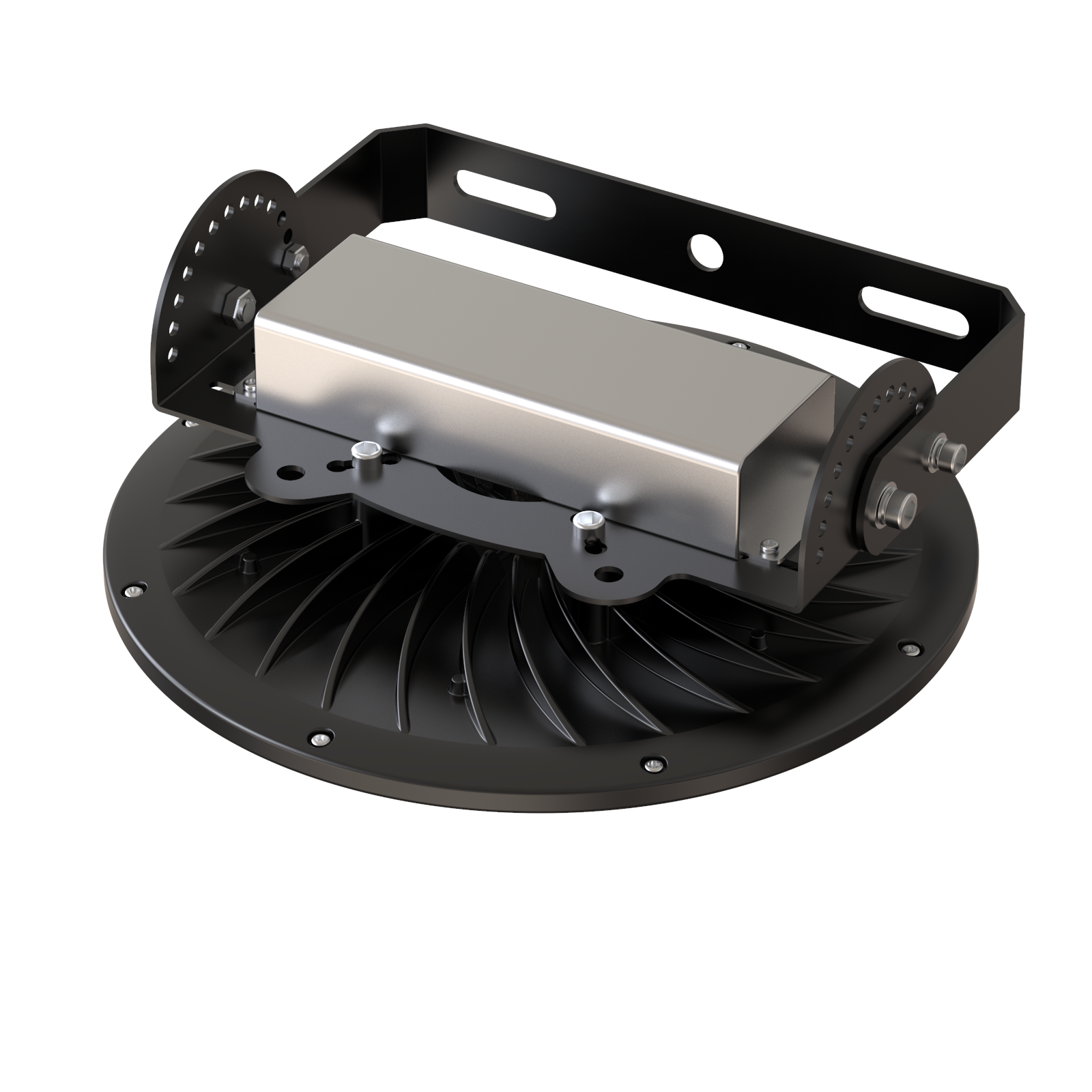
Heat sink fin design is the primary engineering tool for managing the final thermal resistance in the chain — the critical step from aluminum surface to ambient air. The following parameters govern fin thermal performance in die-cast LED housings:
Fin Height
Taller fins provide more surface area but are subject to diminishing returns as boundary layer effects reduce convective efficiency at the fin tip. For natural convection (no forced airflow), optimal fin height for commercial LED fixtures is typically 15–35 mm. Fins beyond 40 mm show minimal additional benefit in natural convection conditions and add weight and material cost.
Fin Thickness and Pitch
Thinner fins with tighter spacing maximize surface area per unit volume, but die casting has practical limits. Minimum castable fin thickness is approximately 1.2–1.5 mm using A413 or ADC12 alloys with optimized gate design. Fin pitch (center-to-center spacing) of 4–6 mm is optimal for natural convection — tighter than 4 mm creates restricted channels where boundary layers from adjacent fins merge, significantly reducing heat transfer coefficient.
Fin Orientation
Vertical fins are strongly preferred for natural convection because they allow the buoyancy-driven airflow to rise unobstructed along the full fin length. Horizontal fins trap warm air and significantly reduce convective efficiency. For UFO high bay fixtures mounted with the fin array pointing upward, the radial fin pattern achieves near-optimal vertical airflow from all directions. For street light housings, longitudinal fins aligned with the prevailing airflow direction from vehicle movement provide additional forced convection benefit.
Surface Area Multiplier
The goal of fin design is to maximize the surface area multiplier — the ratio of finned surface area to the projected base area of the housing. Die-cast aluminum housings routinely achieve surface area multipliers of 2.5–4×, meaning the effective cooling surface is 2.5–4 times the flat plate equivalent. This multiplier directly reduces the fin-to-air thermal resistance and is the most impactful single design variable available to the housing engineer.
| Parameter | Optimal Range (Natural Convection) | Effect on Thermal Performance |
|---|---|---|
| Fin height | 15–35 mm | +15–35% surface area vs 10 mm baseline |
| Fin thickness | 1.2–2.5 mm | Thinner = more fins per area, ↑ surface area |
| Fin pitch | 4–6 mm | Tighter than 4 mm reduces convection coefficient |
| Fin orientation | Vertical preferred | Vertical vs horizontal: up to 40% better convection |
| Surface area multiplier | 2.5–4× | Direct linear reduction in fin-to-air Rth |
| Surface finish | Dark anodize or matte powder coat | ↑ emissivity from 0.05 (bare Al) to 0.85–0.95 (coated) |
Surface finish tip: Bare polished aluminum has an emissivity of only 0.05, meaning very little heat is radiated. Matte powder coating or dark anodizing raises emissivity to 0.85–0.95, making radiation a significant contributor to total heat dissipation — particularly valuable in still-air environments where convection is limited. Anerhui’s standard housing finishes are optimized for both corrosion protection and thermal emissivity. See our LED housing surface treatments guide for detailed emissivity and corrosion performance data.
5. Alloy Selection for Thermal Performance
Not all die-cast aluminum alloys perform equally from a thermal standpoint. The following comparison covers the three alloys most commonly used in heat dissipation LED housing production, with guidance on when to specify each.
| Property | A380 | ADC12 / A383 | A413 |
|---|---|---|---|
| Thermal Conductivity (W/m·K) | 96 | 92 | 121 |
| Tensile Strength (MPa) | 317 | 310 | 296 |
| Die-Filling Fluidity | Good | Better | Best |
| Min. Castable Fin Thickness | 1.8 mm | 1.5 mm | 1.2 mm |
| Corrosion Resistance | Good | Good | Excellent |
| Relative Material Cost | Base (1.0×) | 1.03–1.05× | 1.08–1.12× |
| Best For | General commercial housings, standard high bays | Thin-wall fins, smart sensor compartments | High-power (150W+), maximum thermal priority |
For buyers sourcing LED high bay housings at 100W and below, A380 delivers fully adequate thermal performance at the lowest cost. For 150W+ applications — particularly in high-ambient environments above 40°C — specifying A413 provides a meaningful Tj reduction of 8–12°C at equivalent fin geometry, which translates directly to extended LED life. Contact Anerhui’s engineering team to discuss alloy selection for your specific wattage and ambient temperature requirements.
6. Heat Dissipation Design by Product Type
UFO LED High Bay Housing — Radial Fin Thermal Design
UFO high bay fixtures represent the most thermally demanding common application in commercial LED lighting, combining high power density (100–250W in a compact form factor) with enclosed mounting conditions that limit natural airflow. Anerhui’s UFO high bay housings use a radial fin array with 20–28 fins arranged around the full circumference, delivering 360° convective cooling regardless of the fixture’s rotational position during installation. The central LED mounting platform is thermally bonded to the fin array base through a thick aluminum web, minimizing conductive resistance between the LED MCPCB and the fin structure. Browse our LED high bay light housing range.
LED Street Light Housing — Longitudinal Fin Design
Street light housings face a different thermal challenge: the fixture is oriented horizontally, and the primary heat flow path must be through the upper housing surface to fins exposed to airflow. Anerhui’s street light housings use longitudinal fins aligned along the length of the housing, optimized for the airflow generated by vehicle traffic and natural wind. The driver compartment is thermally isolated from the LED compartment by an internal barrier, preventing driver heat from adding to the LED thermal load. View our LED street light housing range.

LED Canopy Light Housing — Low-Profile Thermal Design
Canopy lights for gas stations and covered parking structures are mounted flush against ceiling surfaces, which significantly restricts the upper-side airflow available to conventional fin arrays. Anerhui’s canopy light housings address this through perimeter-fin designs where the heat dissipation fins are positioned at the outer edge of the fixture, exposed to the ambient air around the fixture perimeter rather than relying on top-surface convection. This approach maintains effective thermal performance even in the most restrictive ceiling-mount conditions. Explore the LED canopy light housing range.
LED Wall Pack Housing — Vertical-Surface Thermal Design
Wall pack fixtures mounted on vertical building surfaces benefit from natural convection rising along the fin surfaces. Anerhui’s wall pack housings orient heat sink fins vertically, aligned with the convective airflow direction, and position the LED mounting surface at the front of the housing with the fin array extending rearward toward the wall. A thermal barrier between the housing back plate and the mounting wall prevents heat from being conducted into the building structure. See the full LED wall pack housing range.
7. Testing & Validating Thermal Performance
Specifying good thermal design is not sufficient — performance must be verified through standardized testing before production commitment. The following test methods are used to validate heat dissipation LED housing performance at Anerhui and should be requested from any supplier.
LM-79: Photometric and Electrical Testing of SSL Luminaires
IES LM-79 defines the procedure for measuring total luminous flux, efficacy, and electrical characteristics of SSL luminaires at stabilized thermal conditions. LM-79 testing requires the fixture to reach thermal equilibrium (typically 30–60 minutes of operation) before measurements are taken, ensuring that reported lumen output reflects real operating conditions rather than cold-start performance.
LM-80: LED Package Lumen Maintenance Testing
IES LM-80 measures the lumen depreciation rate of LED packages at three standard temperatures (55°C, 85°C, and optionally 105°C) over 6,000+ hours. Combined with TM-21 projections, LM-80 data allows prediction of L70 lifetime (the point at which lumen output falls to 70% of initial). Housing thermal design determines which LM-80 temperature rating is relevant for the actual fixture — a well-designed housing that achieves 55°C case temperature allows use of the best-case LM-80 lifetime projections.
Thermal Resistance Measurement (Rth,j-c)
Direct measurement of junction-to-case thermal resistance validates the thermal path from LED package through housing to the fin surface. This measurement, combined with the known fin-to-air resistance from CFD simulation, allows accurate prediction of junction temperature under real operating conditions without requiring direct junction temperature measurement.
In-Field Temperature Validation
After installation, thermal validation using thermocouple measurements at the LED MCPCB surface (case temperature) and the fin tip (ambient reference) allows verification that the installed fixture performs within design parameters. Anerhui provides a thermocouple installation guide and target temperature ranges for each housing product for use during commissioning of large commercial installations.
8. How Thermal Management Directly Affects Lumen Depreciation & Lifespan
The business case for investing in quality heat dissipation LED housing is most clearly expressed through its impact on total cost of ownership. The following model illustrates the lifespan and cost implications of a 20°C junction temperature difference for a 200-fixture commercial warehouse installation operating 20 hours/day.
| Metric | Poor Thermal Housing (Tj = 95°C) | Anerhui Die-Cast Housing (Tj = 75°C) |
|---|---|---|
| LED L70 lifetime (TM-21 projection) | ~36,000 hours | ~80,000 hours |
| Years to L70 (20 hrs/day) | ~4.9 years | ~11 years |
| Driver capacitor life (Ta +10°C) | ~25,000 hours | ~50,000 hours |
| Replacements needed (10yr, 200 fixtures) | ~160 replacements | ~20 replacements |
| Replacement + labor cost (10yr, $45/unit) | $7,200 | $900 |
| Housing unit price premium | Base | +$4.50/unit ($900 total) |
| 10-Year Total Maintenance Saving | $5,400 saved — 3× ROI on housing quality investment | |
This model is conservative — it excludes the revenue impact of lumen output degradation (customers receiving less light than contracted) and the warranty claim costs that accompany premature fixture failure. For commercial lighting projects with performance guarantees or LEED certification requirements, these factors make high-quality thermal housing design even more financially compelling.
Ready to specify heat dissipation LED housings?
Anerhui’s engineering team provides thermal simulation reports, alloy recommendations, and DFM reviews for every custom housing project — at no cost before tooling commitment. Contact us for a thermal design consultation →
9. Sourcing Heat Dissipation LED Housings: What to Look For
When evaluating suppliers for heat dissipation LED housing components, use the following checklist to assess thermal engineering capability — not just production capacity.
Design & Engineering
- In-house CFD thermal simulation capability (not outsourced)
- Demonstrated LM-79 / LM-80 data from previous products
- Alloy selection guidance based on your wattage and ambient temperature
- DFM review that includes thermal resistance analysis of proposed fin geometry
Manufacturing Precision
- Fin thickness tolerance: ±0.05 mm or better (thinner tolerance = more consistent thermal performance)
- Surface roughness control on fin surfaces (Ra ≤ 3.2 µm for optimal convection)
- Consistent alloy composition verified by in-house spectrometer (prevents substitution of lower-grade alloys)
Quality Verification
- Thermal resistance test reports available for standard product lines
- In-house temperature measurement capability for first-article validation
- X-ray inspection availability for internal porosity in thick-section housing bases
Surface Treatment Options
- Matte powder coating (emissivity ≥ 0.85) as standard option
- Dark anodizing for maximum emissivity in high-ambient applications
- Salt spray test reports (ASTM B117) for outdoor housing corrosion protection
For a comprehensive supplier qualification framework covering smart-capable and thermal-performance housings together, download our LED housing supplier audit guide.
10. Frequently Asked Questions About Heat Dissipation LED Housing
Why is heat dissipation so critical for LED housing design?
LED junction temperature is the single most critical factor affecting luminaire lifespan and lumen output. For every 10°C rise above the rated maximum junction temperature, LED service life decreases by approximately 50%. A well-designed heat dissipation LED housing keeps junction temperatures low by conducting heat away from the LED package through aluminum fins into surrounding air, directly translating to longer lifespan, stable lumen output, and reduced warranty claims.
What is the thermal conductivity of die-cast aluminum LED housing?
Die-cast aluminum LED housings achieve thermal conductivity of 92–121 W/(m·K) depending on alloy — A380 delivers ~96 W/(m·K), A413 reaches 121 W/(m·K). By comparison, engineering plastics offer only 0.1–0.3 W/(m·K), making aluminum 500–700× more thermally conductive. This difference results in measured junction temperature reductions of 15–30°C versus plastic housings under identical operating conditions.
How does fin geometry affect heat dissipation in LED housings?
Fin geometry determines effective cooling surface area. Die-cast aluminum allows fins as thin as 1.2 mm with 4 mm pitch, creating arrays with 2.5–4× the effective surface area of a flat shell. Key parameters are fin height (15–35 mm optimal), thickness (1.2–2.5 mm), pitch (4–6 mm for natural convection), and orientation (vertical fins maximize buoyancy-driven airflow). Surface coating with matte powder or dark anodize raises emissivity from 0.05 to 0.85+, adding significant radiative heat transfer.
What is LED junction temperature and what is the safe operating range?
LED junction temperature (Tj) is the temperature at the semiconductor p-n junction — the most critical thermal point in any LED system. Most commercial LEDs are rated for Tj,max of 125°C–150°C, but optimal operating range for maximum lifespan is 60°C–85°C. A properly designed heat dissipation LED housing maintains Tj in this range even at 40–55°C ambient in industrial or outdoor environments.
What is the best aluminum alloy for heat dissipation LED housing?
For maximum thermal performance, A413 alloy (121 W/m·K thermal conductivity, best die-filling fluidity for thin fins, minimum castable thickness 1.2 mm) is the top choice for high-power fixtures (150W+). For most commercial applications up to 150W, A380 offers the optimal balance of thermal performance (96 W/m·K), mechanical strength, and cost. ADC12 is preferred when both thin-wall sensor compartments and good thermal performance are needed simultaneously.
How does housing thermal design reduce lumen depreciation?
Lower junction temperature directly slows lumen depreciation. LEDs at 55°C Tj maintain L70 for 100,000+ hours (TM-21 projection); the same LEDs at 85°C Tj reach L70 in approximately 50,000 hours. A heat dissipation housing achieving a 30°C Tj reduction effectively doubles usable fixture lifetime — from ~5 years to ~11 years at 20 hours/day operation — with direct impact on replacement costs, warranty claims, and customer satisfaction.
Can I request thermal simulation data before ordering LED housings from Anerhui?
Yes. Anerhui provides CFD thermal simulation reports showing predicted junction temperatures at your specified drive current, ambient temperature, and mounting conditions as part of our pre-tooling DFM review process — at no additional cost. This allows thermal performance to be verified and fin geometry to be optimized before steel is cut. Contact our engineering team to request a thermal simulation →
Conclusion
Heat dissipation LED housing is not a passive component — it is an active thermal management system that determines every meaningful performance metric of your LED luminaire. From junction temperature and lumen depreciation to driver life and warranty costs, the quality of the aluminum enclosure and its fin geometry directly controls how long your fixtures perform to specification.
Die-cast aluminum, with its combination of thermal conductivity, three-dimensional fin design freedom, and production precision, remains the clear engineering choice for commercial lighting applications. Whether you are sourcing UFO high bay housings for a logistics center, street light housings for a smart city project, or canopy housings for gas station networks, the thermal engineering of the enclosure deserves the same scrutiny as the LED package and driver specifications.
Anerhui has specialized in die-cast aluminum LED housing thermal design for over 15 years, supplying B2B buyers across Southeast Asia, the Middle East, and North America with housings validated for thermal performance at commercial scale. Contact our engineering team to discuss your thermal requirements, request a free housing sample, or explore our complete product range.
References & Further Reading
- Illuminating Engineering Society (IES) — LM-79, LM-80, TM-21 standards
- U.S. Department of Energy — LED Basics & Junction Temperature
- International Electrotechnical Commission (IEC) — IEC 60598 luminaire standards
- The Aluminum Association — Alloy thermal property data
- Anerhui: Die-Cast Aluminum LED Housing Complete Guide
- Anerhui: Smart LED Housing Design Guide
- Anerhui: How Die-Cast Aluminum LED Lights Are Made
© 2025 Anerhui Lighting Technology Co., Ltd. All rights reserved. | Privacy Policy | Sitemap | Blog
This article is reviewed annually and updated to reflect current thermal management standards and Anerhui product developments.