
By Anerhui Engineering Team | Last updated: May 2026 | LED canopy light housing · gas station · IP65 · die-cast ADC12 aluminum · perimeter fin · Zone 2 ATEX
The LED canopy light housing is one of the most thermally demanding commercial lighting applications — ceiling-flush mounting blocks the top housing surface from natural airflow, concentrating all heat dissipation on the fixture perimeter. Gas station forecourts add fuel vapor exposure requirements. Covered parking adds pressure washing and vehicle exhaust considerations.
This guide covers the complete technical specification for LED canopy light housings — from perimeter fin thermal design and IP ratings to Zone 2 ATEX requirements, wattage selection for gas station forecourts, and sourcing from Anerhui. For related guides see our waterproof LED housing guide, heat dissipation LED housing guide, and commercial LED housing guide.
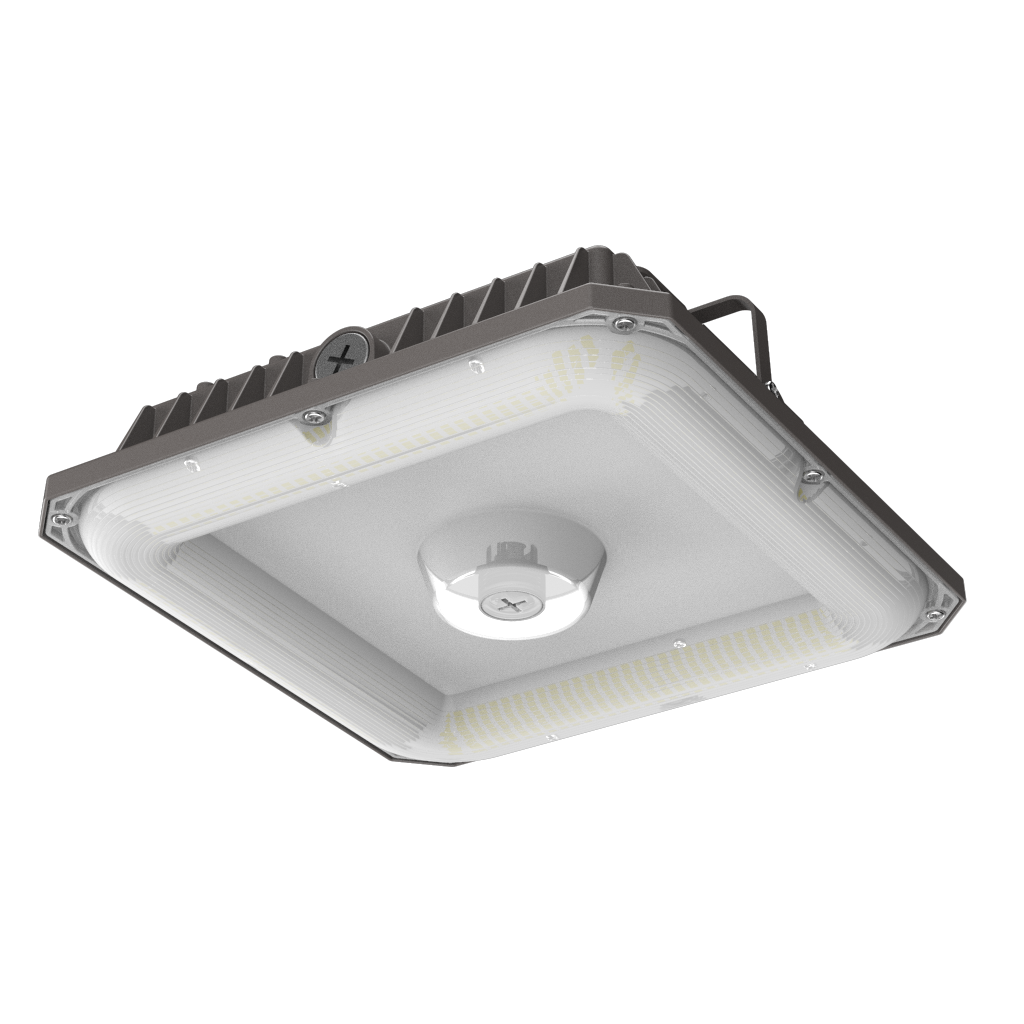
1. What Is an LED Canopy Light Housing?
An LED canopy light housing is a die-cast aluminum luminaire enclosure designed for ceiling-flush mounting on the underside of canopy structures. Unlike pendant-mount or pole-mount fixtures, canopy lights are pressed directly against the ceiling surface — a mounting geometry that fundamentally changes the thermal management requirements and determines the housing’s fin design.
Common canopy light applications include:
- Gas station and petrol station forecourts
- Covered parking entrance canopies
- Drive-through commercial facilities (banks, fast food, car washes)
- Building entrance canopies and porte-cocheres
- Loading dock covered areas
- Outdoor commercial mall covered walkways
Canopy light housings are supplied as SKD kits — the lighting manufacturer installs their own LED module, driver, and wiring harness. The housing provides thermal management, IP protection, optical mounting surface, and structural support for ceiling attachment.
2. The Perimeter Fin Thermal Challenge
The ceiling-flush mounting of canopy lights creates the most constrained natural convection environment in commercial LED lighting. Understanding why perimeter fin design is essential — not optional — for canopy light housings is the foundation of correct product specification.
Why Standard Top-Fin Designs Fail in Canopy Applications
Standard LED housings (UFO high bay, wall pack, street light) position heat dissipation fins on the top or sides of the housing where natural convection — hot air rising, cool air replacing it — efficiently removes heat. In ceiling-flush canopy mounting:
- The top housing surface contacts or comes within centimeters of the ceiling structure
- This eliminates all natural convection airflow across top-mounted fins
- A standard housing mounted flush to a ceiling may see junction temperatures 20–35°C higher than its rated specification
- At 35°C above rated Tj, LED lifetime reduces by approximately 50% and driver lifetime by 30–40%
How Perimeter Fin Design Solves This
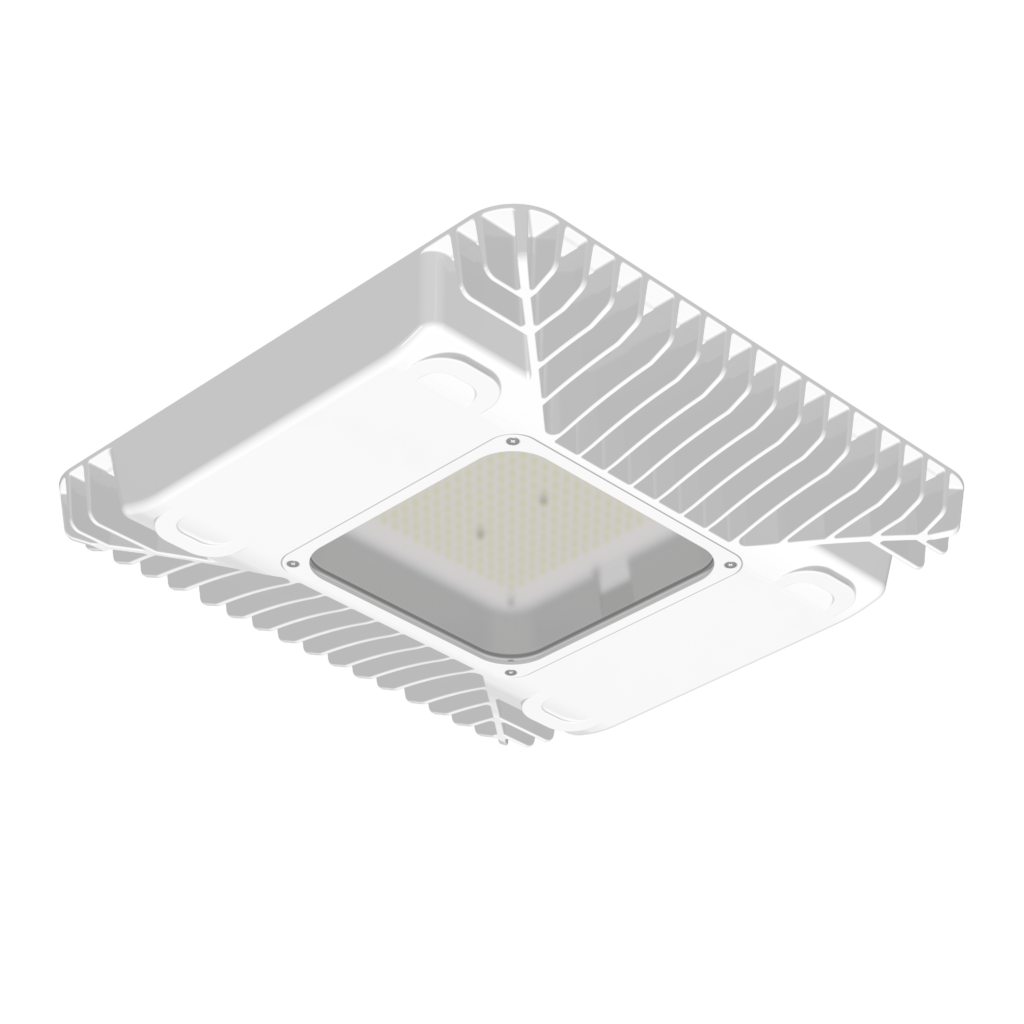
Anerhui’s canopy light housings use a perimeter fin array positioned at the outer edge of the housing disc. These fins extend downward and outward from the housing perimeter, remaining fully exposed to ambient airflow from the sides and below regardless of ceiling clearance. The perimeter fin geometry:
- Maintains effective convective cooling with as little as 10mm ceiling clearance
- Creates lateral airflow channels that draw cool air from the perimeter and exhaust warm air at the outer fin tips
- Achieves equivalent effective surface area to top-fin designs while operating entirely within the exposed lower hemisphere
3. Wattage Selection for Gas Station Forecourts
Gas station canopy lighting specification is governed by IES RP-2 (Lighting for Automobile Dealerships and Service Facilities) and local energy codes. The primary target is maintaining adequate illuminance at the fuel dispenser level for safe fueling operations and security.
| Station Type | Canopy Height | Target Illuminance | Recommended Wattage | Fixture Spacing |
|---|---|---|---|---|
| Standard 2-bay station | 4–5 m | 200–300 lux | 100W–150W | 3–4 m |
| Large multi-bay station | 5–6 m | 200–300 lux | 150W–200W | 3–4 m |
| Premium branded station | 4–5 m | 300–500 lux | 150W–200W | 3 m |
| Covered parking entrance | 3–4 m | 100–200 lux | 60W–100W | 4–5 m |
| Drive-through lane | 3–4 m | 100–200 lux | 60W–100W | 4–5 m |
| Building entrance canopy | 3–4 m | 200–300 lux | 80W–150W | 2–3 m |
Color temperature recommendation: 4000K–5000K is standard for gas station forecourt lighting — the cooler color temperature improves visibility, color rendering of vehicle paintwork, and customer perception of brightness. 3000K warm white is appropriate for luxury hospitality entrance canopies where ambiance is a priority.
4. IP Rating for Canopy Applications
IP54 vs IP65 — Which Is Required?
The correct IP specification depends on the canopy’s exposure to water and dust:
| Canopy Position | Exposure | Min IP Rating | Recommended |
|---|---|---|---|
| Interior of forecourt canopy (sheltered) | Splash, light dust | IP54 | IP65 |
| Canopy edge (direct rain exposure) | Rain, pressure washing | IP65 | IP65 |
| Gas station forecourt (all positions) | Rain, pressure washing, fuel vapor | IP65 | IP65 |
| Car wash canopy | High-pressure water, chemical exposure | IP66 | IP66 |
| Coastal forecourt (<5km ocean) | Salt spray, rain, pressure washing | IP65 | IP66 + e-coat |
All Anerhui canopy light housings are IP65 rated as standard. IP66 is available on request for car wash and coastal applications. For full IP specification data, see our waterproof LED housing guide.
5. Zone 2 ATEX Specification for Gas Stations
Important: In many jurisdictions, luminaires installed in Zone 2 classified areas at gas station forecourts must carry ATEX Zone 2 certification in addition to standard IP65 protection. Failure to specify correctly may create liability exposure and fail electrical inspection. Always confirm Zone 2 area classification with the project’s electrical engineer before specifying luminaires.
Understanding Zone 2 Classification
At gas station forecourts, the ATEX Zone 2 area typically includes:
- Within 0.5 meters of fuel dispenser nozzles and fill caps
- Within 1.5 meters above ground level in the immediate dispenser zone
- Vent pipe outlets from underground storage tanks (0.5 meter radius)
Luminaires installed outside the Zone 2 boundary on a standard gas station canopy require IP65 but do not require ATEX certification. Luminaires directly above dispensers within the Zone 2 boundary require both IP65 and ATEX Zone 2 certification.
ATEX Zone 2 Options from Anerhui
Anerhui’s canopy light housing is available with Zone 2 ATEX-compatible construction on request. The ATEX variant uses:
- Ex ec (increased safety) or Ex nA (non-sparking) enclosure classification
- Temperature class T4 (maximum surface temperature 135°C) or T5 (100°C)
- Cable gland and conduit entry rated for Zone 2
- All internal metallic components bonded for static dissipation
Minimum order for ATEX Zone 2 canopy housing: 200 units. Lead time: 6–8 weeks. Contact Anerhui’s engineering team to discuss ATEX specification requirements for your project.
6. Surface Treatment for Canopy Environments
Gas station canopy environments are chemically aggressive — fuel vapor, vehicle exhaust, cleaning chemicals, and UV exposure combine to accelerate surface coating degradation more rapidly than standard outdoor environments.
| Environment | Recommended Treatment | ASTM B117 |
|---|---|---|
| Standard forecourt | TGIC polyester powder coat | 500–800 hrs |
| High-traffic / tropical | Superdurable polyester powder coat | 1,000–1,200 hrs |
| Coastal forecourt | E-coat + superdurable powder coat | 1,500+ hrs |
| Car wash canopy | Epoxy primer + superdurable powder coat | 1,200+ hrs |
White (RAL 9003) and light grey (RAL 7035) are common canopy light housing colors for gas station applications — both reflective finishes contribute to luminaire efficiency by reflecting light downward rather than absorbing it. For full surface treatment data, see our LED housing surface treatments guide.
7. Application Guide by Canopy Type
| Application | Wattage | IP | CCT | Special Requirement |
|---|---|---|---|---|
| Gas station forecourt (standard zone) | 100W–200W | IP65 | 4000K–5000K | IES RP-2 compliance |
| Gas station (Zone 2 area) | 100W–150W | IP65 | 4000K | ATEX Zone 2 certification |
| Covered parking entrance | 60W–100W | IP65 | 4000K | Full coverage uniformity |
| Drive-through lane | 60W–100W | IP65 | 4000K | Glare control for drivers |
| Building entrance canopy | 80W–150W | IP65 | 3000K–4000K | Architectural finish |
| Car wash canopy | 100W–200W | IP66 | 5000K | Chemical-resistant coating |
| Coastal forecourt | 100W–200W | IP66 | 4000K–5000K | E-coat + superdurable; A4 SS hardware |
| Luxury hospitality porte-cochere | 80W–150W | IP65 | 2700K–3000K | Custom RAL finish; CRI 90 |
8. SKD Kit Contents and Documentation
Standard SKD Kit Includes
- Die-cast ADC12 aluminum housing body with perimeter fin array
- Flat tempered glass lens with lens frame (standard) or convex glass lens (optional)
- Full-perimeter silicone gasket (Shore A 50, pre-installed)
- Stainless steel A2 locking fasteners
- IP65-rated ceiling conduit entry gland
- Surface mount ceiling bracket
- Product label (IP65, wattage range)
Documentation (Every Shipment)
- ADC12 alloy composition certificate (XRF spectrometer data)
- IP test report (IEC 60529, fully assembled, third-party accredited)
- ASTM B117 salt spray certificate
- Dimensional inspection report
- Packing list
9. Frequently Asked Questions
What is an LED canopy light housing?
An LED canopy light housing is a die-cast ADC12 aluminum enclosure for ceiling-flush mounting on gas station forecourts, covered parking, drive-through lanes, and building entrance canopies. Perimeter fin design positions heat dissipation at the fixture edge where airflow is unrestricted by the ceiling above. Supplied as SKD kit — buyer installs own LED module and driver. IP65 standard, 40W–300W.
What IP rating does a gas station canopy light need?
IP65 minimum for all forecourt positions — providing complete dust protection and pressure wash resistance. Zone 2 classified areas directly above fuel dispensers additionally require ATEX Zone 2 certification. Car wash canopies require IP66. Coastal forecourts within 5km of the ocean should specify IP66 with e-coat surface treatment.
Why do canopy light housings use perimeter fins?
Ceiling-flush mounting blocks airflow across top-mounted fins. Perimeter fins positioned at the fixture edge remain exposed to side and bottom airflow regardless of ceiling clearance. Without perimeter fins, junction temperatures in ceiling-mount can be 20–35°C higher than specification — reducing LED lifetime by up to 50%.
What wattage canopy light do I need for a gas station?
Standard 2-bay station at 4–5m canopy height: 100W–150W per fixture at 3–4m spacing, achieving IES RP-2 minimum 200 lux at dispenser level. Large multi-bay station or premium branding requiring 300–500 lux: 150W–200W. Always verify with photometric calculation using IES files.
What is Zone 2 ATEX for gas station canopy lighting?
Zone 2 is an ATEX explosive atmosphere classification for areas where fuel vapor may occasionally be present — including within 0.5m of dispenser nozzles and 1.5m above ground in the dispenser zone. Luminaires in Zone 2 must carry ATEX Zone 2 certification (Ex ec or Ex nA) in addition to IP65. Anerhui offers Zone 2 ATEX canopy housing on request (MOQ 200 units). Confirm Zone 2 boundary with your project’s electrical engineer before specifying.
Can LED canopy housings be used for covered parking?
Yes — for covered parking entrance canopies, drive-through lanes, and ground-floor covered bays at 3–5m height. For fully enclosed multi-story parking structures at 6–12m bay height, UFO high bay housings are more appropriate. See our UFO high bay housing guide for parking structure specifications.
Conclusion
LED canopy light housing selection requires understanding the thermal constraints of ceiling-flush mounting, the IP and ATEX requirements of gas station environments, and the surface treatment durability needed for fuel vapor and chemical exposure. Perimeter fin design, IP65 testing on fully assembled housings, and appropriate surface treatment specification are the three most consequential decisions in canopy light housing procurement.
Anerhui’s LED canopy light housing range covers 40W–300W in die-cast ADC12 aluminum, IP54–IP65 standard (IP66 and Zone 2 ATEX available), with perimeter fin thermal design validated by CFD simulation at worst-case canopy mounting conditions.
Contact our team for specifications or browse our canopy light housing range.
References and Further Reading
- IES — RP-2 Lighting for Automobile Dealerships
- IEC — IEC 60529 IP Rating Standard
- ATEX Directive — Explosive Atmosphere Equipment
- Anerhui: Waterproof LED Housing IP Rating Guide
- Anerhui: Heat Dissipation LED Housing Guide
- Anerhui: LED Housing Surface Treatments Guide
- Anerhui: LED Housing SKD Kit Guide
- Anerhui: LED Commercial Lighting Housing Guide
- Anerhui: UFO LED High Bay Housing Guide