
By Anerhui Engineering Team | Last updated: May 2026 | LED housing surface treatment powder coating anodizing e-coat ASTM B117 salt spray corrosion protection
📋 Table of Contents
- Why Surface Treatment Is a Critical Engineering Decision
- Powder Coating: The Most Versatile Option
- Anodizing: Integral Surface Hardening
- E-Coat (Electrophoretic Paint): Maximum Corrosion Baseline
- Chromate Conversion Coating: Adhesion Primer
- Combined Systems: E-Coat + Powder Coat for Harsh Environments
- How Surface Treatment Affects Thermal Performance
- Surface Treatment & IP Rating Integrity
- Full Comparison Table & Selection Guide
- Market-Specific Requirements by Region
- Frequently Asked Questions
Surface treatment is one of the most consequential — and most frequently underspecified — decisions in LED housing design. For a die-cast aluminum luminaire installed outdoors, the surface finish is the primary barrier between the housing and the corrosive forces of rain, salt spray, UV radiation, and industrial atmospheric pollutants. Specify it correctly, and your housing lasts 25 years. Specify it incorrectly for the deployment environment, and visible corrosion can appear within 18 months.
For B2B buyers sourcing die-cast aluminum LED housings, understanding the technical differences between powder coating, anodizing, electrophoretic e-coat, and combined systems is essential for matching the surface finish specification to the deployment environment, regulatory requirements, and cost targets. Surface treatment also directly affects thermal performance through emissivity — a detail that many procurement teams overlook entirely.
This guide covers all four major surface treatment options used on commercial LED housings, with quantitative performance data, ASTM B117 salt spray benchmarks, and a clear selection framework. For related technical context, see our heat dissipation LED housing guide for emissivity impact on thermal management, and our LED light housing manufacturer guide for supplier evaluation criteria including surface treatment capability. Industry standards are published by ASTM International and the International Electrotechnical Commission (IEC).

1. Why Surface Treatment Is a Critical Engineering Decision
Die-cast aluminum is an inherently corrosion-resistant material — far superior to steel in most environments. However, untreated aluminum still forms a natural oxide layer of only 2–5 nm, which is inadequate protection against the chloride ions, sulfur dioxide, and acidic rainfall encountered in coastal, industrial, and urban environments. Left untreated, die-cast A380 aluminum shows visible surface pitting within 6–12 months in ASTM B117 equivalent environments.
Surface treatment for LED housings serves four distinct engineering functions simultaneously:
- Corrosion protection: Creating a barrier between the aluminum substrate and corrosive atmospheric agents — salt spray, acid rain, industrial pollutants, and UV-generated reactive species.
- UV resistance: Preventing photodegradation of the organic or metallic surface layer, which in outdoor fixtures can cause chalking, fading, and loss of adhesion within 3–5 years if UV-stable materials are not specified.
- Thermal emissivity: Dramatically increasing the radiative heat dissipation capability of the housing surface from the negligible emissivity of bare polished aluminum (ε ≈ 0.05) to the high emissivity of coated surfaces (ε = 0.85–0.95).
- Aesthetic specification: Meeting architectural, regional, or brand color requirements — a factor of significant commercial importance in residential-adjacent and architecturally specified projects.
Key insight: Surface treatment selection must be made before finalizing housing design, because different treatments require different pre-treatment steps, masking allowances on gasket surfaces, and dimensional tolerances on threaded features. Changing the surface treatment specification after tooling is cut can require costly mold modifications. Discuss treatment options with your LED light housing manufacturer during the DFM review stage.
2. Powder Coating: The Most Versatile Option for LED Housings
Powder coating is the most widely used surface treatment for commercial outdoor LED housings, and for good reason: it offers the best combination of corrosion protection, color range, UV resistance, thermal emissivity, and cost across the widest range of deployment environments.
MOST COMMON
Thermosetting Powder Coating — Technical Overview
- Process: Electrostatic application of dry polymer powder, cured at 180–200°C for 15–20 minutes — creating a cross-linked, chemically bonded coating layer
- Coating thickness: 60–120 µm (standard: 80 µm for commercial LED housings)
- Hardness: 60–80 HV (Vickers) — good impact resistance
- Corrosion resistance: 500–1,000 hours ASTM B117 (powder coat alone on pre-treated aluminum)
- UV resistance: Excellent with polyester or TGIC polyester chemistry; rated for 10+ years outdoor exposure without chalking
- Emissivity: 0.85–0.95 (matte finishes); 0.80–0.90 (gloss finishes)
- Color options: Any RAL color, metallic, texture, wrinkle, hammer tone
- Cost index: Base (1.0×)
- Lead time impact: Standard colors: +0 days; custom RAL: +3–5 days
Powder Coat Chemistry Selection
Not all powder coating chemistry is equal. For outdoor LED housings, the coating chemistry must be specified explicitly — not left to the applicator’s discretion:
| Chemistry | UV Resistance | Corrosion Resistance | Best Use |
|---|---|---|---|
| Polyester (standard) | Good (5–7 yr outdoor) | Good (500–800 hr B117) | Indoor commercial, sheltered outdoor |
| TGIC Polyester | Excellent (10+ yr outdoor) | Very good (800–1,000 hr B117) | Standard outdoor LED housing specification |
| Superdurable Polyester | Outstanding (15+ yr outdoor) | Very good (1,000+ hr B117) | High UV environments: Middle East, tropical SE Asia, Australia |
| Epoxy-Polyester Hybrid | Poor (not for outdoor use) | Excellent (1,200+ hr B117) | Indoor only — superior chemical resistance |
For LED housings deployed in the Middle East, Southeast Asia, or other high-UV environments, always specify superdurable polyester powder coat chemistry explicitly. Standard polyester will show chalking and color fade within 3–5 years in these conditions. Anerhui’s standard outdoor housing specification uses TGIC polyester as the baseline, with superdurable polyester available on request.

3. Anodizing: Integral Surface Hardening for Aluminum LED Housings
Anodizing is fundamentally different from powder coating: rather than applying an external coating layer, it is an electrochemical conversion process that transforms the aluminum surface itself into aluminum oxide (Al₂O₃). The result is an integral protective layer that cannot peel, chip, or delaminate — because it is part of the metal itself.
METALLIC FINISH
Anodizing — Technical Overview
- Process: Electrochemical oxidation in sulfuric acid electrolyte (Type II) or chromic acid (Type I); hard anodize uses sulfuric acid at low temperature (Type III)
- Layer thickness: Type II (standard): 10–25 µm; Type III (hard anodize): 25–100 µm
- Hardness: 250–500 HV (Type II–III) — significantly harder than powder coat
- Corrosion resistance: 300–600 hours ASTM B117 (Type II, unsealed); 600–1,000+ hours (Type II, sealed)
- UV resistance: Excellent (aluminum oxide is inherently UV stable); color anodize may fade over 7–10 years
- Emissivity: Clear anodize: 0.77–0.82; dark anodize (black): 0.82–0.88
- Color options: Natural silver, black, bronze, gold (limited range vs powder coat)
- Cost index: 1.15–1.30× vs powder coat
- Surface appearance: Metallic — retains visible aluminum grain and texture
When to Specify Anodizing for LED Housings
Anodizing is the preferred surface treatment when one or more of the following conditions apply:
- Architectural specification requiring metallic appearance: Facade lighting, high-end retail, and premium hospitality projects often specify an anodized aluminum look that powder coat cannot replicate.
- High abrasion environments: Type III hard anodizing (250–500 HV) resists surface scratching in applications where fixtures are subject to contact — cleaning equipment, forklift proximity, etc.
- Thinnest possible dimensional buildup: At 10–25 µm, anodizing adds negligible thickness to precision sealing surfaces, reducing the risk of gasket groove interference that can occur with thicker powder coat layers.
- Maximum thermal emissivity for thermal management priority: Dark anodizing achieves emissivity of 0.82–0.88, slightly below matte powder coat but with the surface hardness advantage.
Important limitation: Anodizing performance varies significantly with alloy composition. A380 — the most common die-cast LED housing alloy — anodizes to a darker, less uniform appearance than wrought alloys like 6061 or 6063 due to its high silicon content. For applications where uniform bright anodize appearance is critical, A413 alloy should be specified, as its higher purity produces more consistent anodize results. Discuss alloy selection with your manufacturer before specifying anodize finish on A380 housings.
4. E-Coat (Electrophoretic Paint): Maximum Corrosion Baseline
Electrophoretic coating (e-coat) is an immersion-based paint application process where charged paint particles are deposited onto the grounded aluminum housing by electrical attraction. The result is an extremely uniform, thin film coating that penetrates every surface — including recessed cavities, internal channels, and threaded features — that spray-applied powder coat cannot reach.
BEST CORROSION BASELINE
E-Coat (Cathodic Epoxy) — Technical Overview
- Process: Immersion in paint bath with DC current; cathodic epoxy e-coat is the standard for aluminum LED housings
- Coating thickness: 15–30 µm (highly uniform, including internal surfaces)
- Hardness: 40–60 HV — softer than powder coat; typically used as primer layer
- Corrosion resistance (alone): 500–800 hours ASTM B117
- Corrosion resistance (as primer under powder coat): 1,500–3,000+ hours ASTM B117
- UV resistance: Poor (epoxy e-coat yellows under UV; requires topcoat for outdoor use)
- Coverage: Complete — all surfaces including internal cavities
- Color options: Limited (grey, black primer tones); used as primer, not decorative topcoat
- Cost index: 1.20–1.40× vs powder coat alone
E-coat is rarely used alone on LED housings — its primary application is as a corrosion-barrier primer layer beneath a powder coat topcoat, forming the e-coat + powder coat combined system described in Section 6. For applications requiring complete internal cavity protection — such as smart LED housings with sensor compartments or LoRaWAN antenna cavities — e-coat’s ability to coat internal surfaces that powder coat cannot reach provides a meaningful additional protection layer.
5. Chromate Conversion Coating: Adhesion Primer
Chromate conversion coating (also called chemical film or Alodine/Iridite) is a thin chemical treatment (0.5–2.5 µm) applied to the aluminum surface to improve adhesion for subsequent coatings and provide a basic corrosion barrier. It is not used as a standalone finish for outdoor LED housings — it is always a pre-treatment step applied before powder coating or e-coating.
Trivalent chromate (Cr³⁺) conversion coating has largely replaced hexavalent chromate (Cr⁶⁺) in LED housing manufacturing due to RoHS and REACH regulations that restrict hexavalent chromium. Trivalent chromate provides equivalent adhesion promotion to hexavalent formulations while eliminating the regulatory compliance risk for EU, UK, and California Proposition 65 markets.
When evaluating suppliers, always confirm that pre-treatment processes use trivalent chromate (RoHS-compliant). Request material safety data sheets (MSDS) and RoHS compliance declarations covering pre-treatment chemicals, not just the final coating. Anerhui’s pre-treatment line uses only Cr³⁺ trivalent chromate in compliance with EU RoHS Directive 2011/65/EU.
6. Combined Systems: E-Coat + Powder Coat for Harsh Environments
For LED housings deployed in coastal zones, marine environments, industrial atmospheric exposure, or any application requiring compliance with architectural corrosion specifications above 1,000 hours ASTM B117, the e-coat + powder coat combined system is the industry’s gold standard.
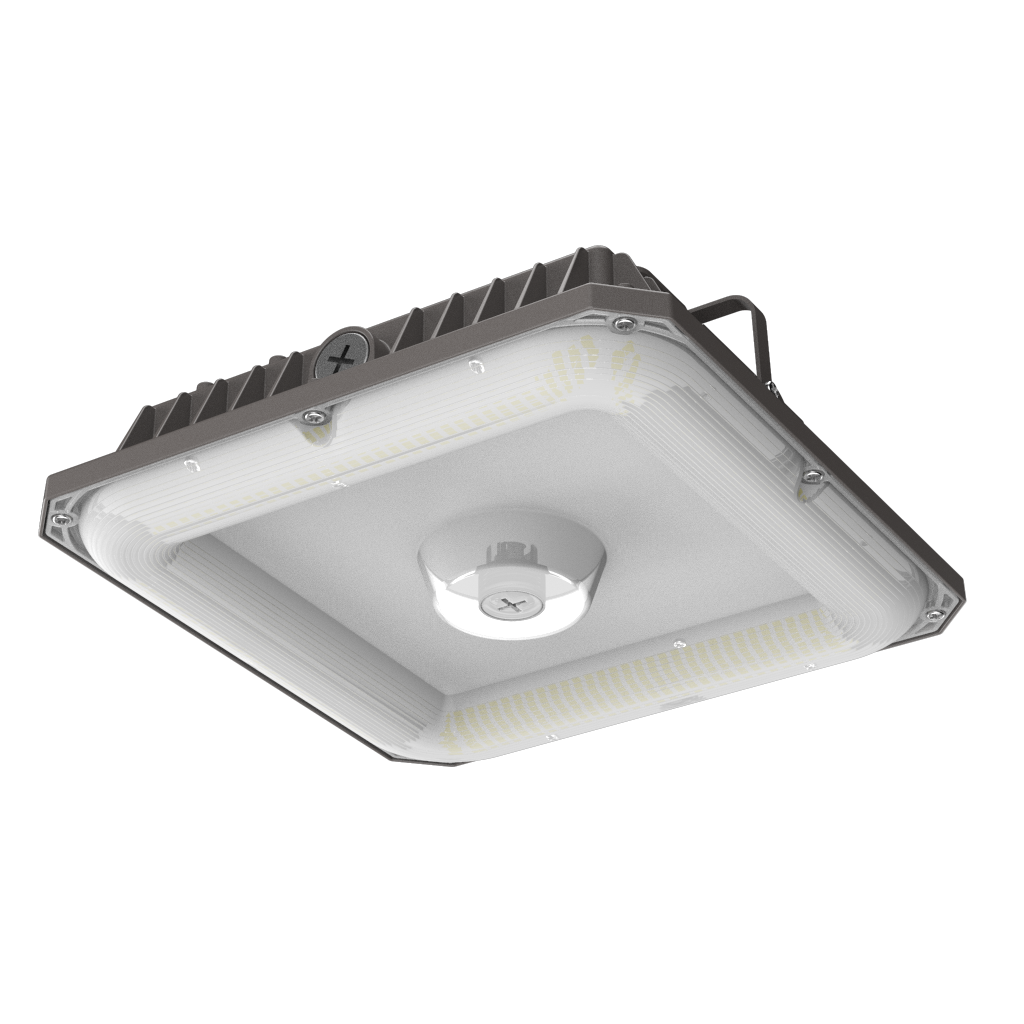
Combined System Process Sequence
- Alkaline degreasing: Remove die casting release agents and machining oils
- Acid etch: Remove natural oxide layer; activate surface for conversion coating
- Trivalent chromate conversion: 0.5–2.5 µm adhesion promotion layer
- Rinse and dry
- E-coat immersion: 15–25 µm cathodic epoxy primer deposited uniformly on all surfaces
- E-coat cure: 175–185°C for 20 minutes
- Powder coat application: 60–80 µm TGIC polyester or superdurable polyester topcoat
- Powder coat cure: 185–200°C for 15–20 minutes
- Post-cure inspection: Adhesion cross-hatch (ASTM D3359), film thickness (ASTM D7091), and visual inspection
| System | ASTM B117 Performance | UV Resistance | Cost Index | Recommended For |
|---|---|---|---|---|
| Powder coat only | 500–1,000 hours | Excellent | 1.0× | Standard inland outdoor |
| Anodize only | 600–1,000 hours (sealed) | Excellent | 1.15–1.30× | Architectural, high abrasion |
| E-coat only | 500–800 hours | Poor (not for outdoor alone) | 1.20–1.40× | Not standalone — primer only |
| E-coat + Powder coat | 1,500–3,000+ hours | Excellent | 1.35–1.55× | Coastal, marine, industrial harsh |
| Anodize + Powder coat | 1,200–2,000 hours | Excellent | 1.40–1.60× | Premium architectural + corrosion |
Specification tip for coastal projects: When specifying LED housings for coastal installations within 1 km of the ocean, always specify the e-coat + powder coat combined system with a minimum ASTM B117 target of 1,500 hours without corrosion creep from scribe. Request third-party test reports from the supplier covering both the combined system and the powder coat topcoat chemistry (confirm superdurable polyester for tropical UV environments). Contact Anerhui’s technical team to discuss coastal specification packages.
7. How Surface Treatment Affects LED Housing Thermal Performance
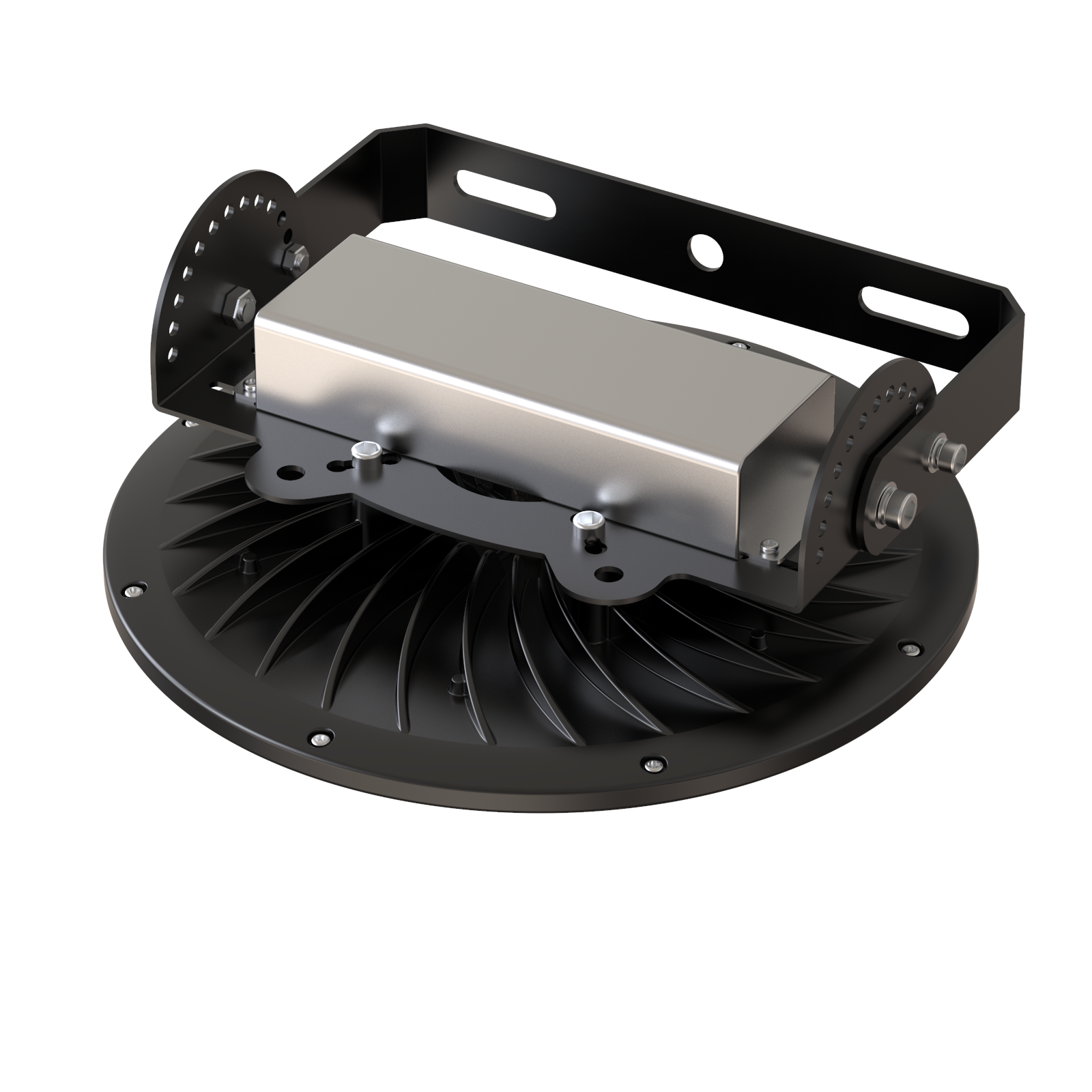
Surface treatment’s impact on thermal performance through emissivity is one of the most underappreciated factors in LED housing specification. Emissivity (ε) describes how efficiently a surface radiates heat compared to a perfect black body radiator. Bare polished aluminum has an emissivity of just 0.03–0.05 — meaning it radiates almost no heat and relies entirely on convection for cooling. Applied surface treatments dramatically change this.
| Surface Treatment | Emissivity (ε) | Radiative Heat Transfer vs Bare Al | Tj Reduction (150W fixture, still air) |
|---|---|---|---|
| Bare polished aluminum | 0.03–0.05 | Baseline | — |
| Clear anodize (Type II) | 0.77–0.82 | +15–18× | 3–5°C |
| Dark anodize (black) | 0.82–0.88 | +17–20× | 4–7°C |
| Gloss powder coat (light color) | 0.80–0.88 | +17–20× | 4–6°C |
| Matte powder coat (dark color) | 0.88–0.95 | +19–22× | 5–8°C |
| E-coat + matte powder coat | 0.88–0.93 | +18–21× | 4–7°C |
For a 150W LED high bay fixture operating in a still-air industrial environment, the difference between bare aluminum and matte dark powder coat represents a junction temperature reduction of 5–8°C. As documented in our heat dissipation LED housing guide, every 10°C reduction in junction temperature approximately doubles LED service life — making surface treatment a meaningful contributor to long-term fixture performance even beyond its corrosion protection role.
8. Surface Treatment & IP Rating Integrity
A detail that is frequently overlooked in LED housing surface treatment specification is the interaction between coating thickness and IP-rated gasket sealing performance. All four surface treatments add material to the housing surface — and if applied to gasket groove mating surfaces, they can prevent proper gasket compression and compromise IP rating.
Critical Masking Requirements
Gasket groove surfaces, lens frame mating faces, cable gland boss threads, and any other sealing-critical features must be masked before coating application to maintain dimensional control. Anerhui’s process controls include:
- Pre-coating masking of all gasket groove surfaces using precision silicone plugs and tape
- Post-coating dimensional verification of gasket groove width and depth using calibrated gauges
- IP spray test on fully assembled housing (with gasket and lens installed) after surface treatment — not on bare housing
Coating Thickness Impact on Threads
Powder coat at 60–80 µm adds 60–80 µm per surface to threaded features. For M4 and M5 screws in mounting holes, this is generally acceptable. However, for precision cable gland threads (PG13.5, PG16, M20) and Zhaga socket interfaces, coating buildup must be controlled to prevent thread interference. Anerhui masks all functional threads before powder coat application and re-chases threads as required in post-coating CNC operations for smart LED housings with Zhaga Book 18 sockets.
Procurement checklist: Always request IP test reports performed on fully assembled, surface-treated housings — not on bare castings. A bare casting that passes IP67 can fail IP54 after coating if gasket surfaces are not properly masked. This is one of the most common sources of field IP failures in LED housings from commodity suppliers. See our LED housing supplier audit guide for the full IP qualification checklist.
9. Full Comparison Table & Surface Treatment Selection Guide
| Criteria | Powder Coat (TGIC) | Anodize (Type II) | E-Coat Only | E-Coat + Powder Coat |
|---|---|---|---|---|
| ASTM B117 (hours) | 500–1,000 | 600–1,000 | 500–800 | 1,500–3,000+ |
| UV resistance | Excellent | Excellent | Poor | Excellent |
| Emissivity | 0.85–0.95 | 0.77–0.88 | 0.85–0.90 | 0.88–0.93 |
| Surface hardness | 60–80 HV | 250–500 HV | 40–60 HV | 60–80 HV |
| Appearance | Any RAL, matte/gloss/texture | Metallic silver/black/bronze | Primer only | Any RAL over e-coat primer |
| IP gasket compatibility | Good (requires masking) | Best (thinnest buildup) | Good (requires masking) | Good (requires masking) |
| RoHS compliance | ✅ Yes | ✅ Yes (Cr³⁺ seal) | ✅ Yes | ✅ Yes |
| Relative cost | 1.0× | 1.15–1.30× | 1.20–1.40× | 1.35–1.55× |
| Best for | Standard outdoor, inland | Architectural, high abrasion | Combined system primer | Coastal, marine, industrial harsh |
Quick Selection Guide by Deployment Environment
| Deployment Environment | Recommended Treatment | Minimum ASTM B117 Target |
|---|---|---|
| Indoor commercial (warehouse, factory) | Standard powder coat (polyester) | 500 hours |
| Inland outdoor (low humidity, low pollution) | TGIC polyester powder coat | 500–800 hours |
| Urban outdoor (moderate pollution, acid rain) | TGIC polyester powder coat | 800–1,000 hours |
| High UV (Middle East, tropical SE Asia, Australia) | Superdurable polyester powder coat | 1,000 hours + UV cycle test |
| Coastal (within 5 km of ocean) | E-coat + superdurable powder coat | 1,500+ hours |
| Marine / direct salt spray | E-coat + superdurable powder coat | 2,000+ hours |
| Industrial / chemical atmosphere | E-coat + powder coat or anodize + powder coat | 1,500+ hours |
| Architectural / premium aesthetic | Anodize (Type II, sealed) or anodize + powder coat | 1,000 hours |
10. Market-Specific Surface Treatment Requirements by Region
Different global markets have developed distinct surface treatment standards and buyer expectations for commercial LED housings. Understanding these regional differences helps procurement teams avoid specification mismatches and ensure market acceptance.
| Market | Typical Specification | Key Concern | Anerhui Standard |
|---|---|---|---|
| North America (US/Canada) | TGIC polyester powder coat, RAL 9005 / 9003 / 7035 most common | UV resistance, DLC compliance documentation | TGIC polyester standard; superdurable on request |
| European Union | RoHS-compliant pre-treatment (Cr³⁺ mandatory), REACH-compliant coating | Hexavalent chromium (Cr⁶⁺) prohibition; REACH SVHC compliance | Cr³⁺ trivalent pre-treatment standard; full REACH declaration available |
| Middle East (UAE, Saudi Arabia) | Superdurable polyester mandatory; white / grey preferred; IP66+ | Extreme UV (UV index 10–12); sand abrasion; high ambient temperature | Superdurable polyester + IP66 tested; light RAL colors in stock |
| Southeast Asia (tropical) | Superdurable polyester or e-coat + powder coat; IP65+ standard | High humidity, tropical UV, salt air in coastal installations | E-coat + superdurable powder coat available for coastal projects |
| Australia / New Zealand | Superdurable polyester (AS/NZS 4506); coastal e-coat + powder coat | High UV index; coastal salt spray; bushfire smoke corrosion | Superdurable standard; AS/NZS compliance documentation available |
Need surface treatment documentation for your market?
Anerhui provides full surface treatment compliance documentation including ASTM B117 test reports, RoHS/REACH declarations, coating chemistry data sheets, and film thickness certificates for all major export markets.
📋 Request Compliance Documentation | 📦 Request Treated Housing Sample | 🔍 Browse Product Range
11. Frequently Asked Questions About LED Housing Surface Treatments
What is the best surface treatment for outdoor LED housings?
For most outdoor LED housing applications, TGIC polyester powder coating (60–120 µm) offers the best balance of corrosion protection (1,000+ hours ASTM B117), UV resistance, color options, and cost. For coastal or marine environments, an e-coat + powder coat combined system provides superior protection exceeding 2,000 hours ASTM B117. Anodizing is preferred when a metallic appearance is required.
What is the difference between powder coating and anodizing for LED housings?
Powder coating is an applied organic polymer coating (60–120 µm) providing a colored surface with excellent corrosion and UV protection. Anodizing electrochemically converts the aluminum surface itself into aluminum oxide (10–25 µm) — an integral layer that cannot peel or chip, with much higher hardness (250–500 HV vs 60–80 HV for powder coat). Powder coat offers more color options and better impact resistance; anodizing offers metallic appearance and better abrasion resistance. Both achieve IP65–IP67 when properly applied with masking of sealing surfaces.
How does surface treatment affect LED housing thermal performance?
Surface treatment dramatically affects radiative heat dissipation through emissivity. Bare polished aluminum has emissivity of only 0.03–0.05. Matte dark powder coat raises this to 0.88–0.95, and dark anodizing achieves 0.82–0.88. In a 150W LED fixture operating in still air, this emissivity improvement reduces steady-state junction temperature by 5–8°C — meaningfully extending LED service life. See our heat dissipation LED housing guide for detailed thermal modeling.
What is ASTM B117 salt spray testing for LED housings?
ASTM B117 is the standard accelerated corrosion test exposing coated metal to continuous 5% NaCl salt fog at 35°C. For LED housings, typical targets are: powder coat alone — 500–1,000 hours; e-coat + powder coat — 1,500–3,000 hours. Coastal and marine specifications often require 1,500+ hours minimum. Always request third-party B117 test reports — not self-declared figures — from suppliers.
What RAL colors are available for powder-coated LED housings?
Die-cast aluminum LED housings can be powder coated in any RAL color. Most common standard options are RAL 9005 (jet black, matte), RAL 9003 (signal white), RAL 7035 (light grey), RAL 6005 (moss green), and RAL 9007 (grey aluminium). Custom RAL colors are available with MOQ of 500 units and 3–5 additional days lead time. Metallic, wrinkle, hammer tone, and fine texture finishes are also available.
Can LED housing surface treatments affect IP rating integrity?
Yes. Coating buildup on gasket groove mating surfaces can prevent proper gasket compression and compromise IP ratings. Professional manufacturers mask all sealing-critical surfaces before coating application and verify gasket groove dimensions post-coating. Always request IP test reports performed on fully assembled, surface-treated housings — not bare castings. Anerhui performs IP testing on every housing variant in fully assembled configuration after surface treatment.
Conclusion
LED housing surface treatment is far more than a cosmetic specification. The choice between powder coating, anodizing, e-coat, or combined systems determines corrosion lifespan, UV stability, thermal emissivity, IP rating reliability, and regulatory compliance across your target markets — all of which directly affect product quality, warranty exposure, and customer satisfaction over the fixture’s 25-year service life.
The selection framework is clear: TGIC polyester powder coat for standard outdoor applications; superdurable polyester for high-UV markets; e-coat + superdurable powder coat for coastal and marine environments; and anodizing for architectural projects requiring metallic aesthetics or high abrasion resistance. Every specification should be backed by third-party ASTM B117 test reports and RoHS/REACH compliance declarations from your manufacturer.
Anerhui supplies die-cast aluminum LED housings with in-house powder coating capability, full surface treatment documentation, and the technical expertise to match your treatment specification to your deployment environment and target market. Contact our team to discuss surface treatment options for your next project, or request a treated housing sample for evaluation.
References & Further Reading
- ASTM International — ASTM B117 Salt Spray Test Standard
- International Electrotechnical Commission (IEC) — IEC 60529 IP Ratings
- The Aluminum Association — Aluminum alloy anodizing and surface treatment data
- EU RoHS Directive 2011/65/EU — Hexavalent chromium restriction
- Anerhui: Heat Dissipation LED Housing Guide — Emissivity & Thermal Management
- Anerhui: LED Light Housing Manufacturer Selection Guide
- Anerhui: Smart LED Housing Design Guide
- Anerhui: Die-Cast Aluminum LED Housing Complete Guide
© 2026 Anerhui Lighting Technology Co., Ltd. All rights reserved. | Privacy Policy | Sitemap | Blog
This article is reviewed annually and updated to reflect current surface treatment standards and Anerhui product capabilities.