
By Anerhui Engineering Team | Last updated: May 2026 | industrial LED housing warehouse LED housing UFO high bay housing factory lighting housing die-cast aluminum
📋 Table of Contents
- Why Industrial Environments Demand Specialized LED Housings
- Thermal Requirements: High Power, Continuous Operation
- IP Ratings & Vibration Resistance for Industrial Settings
- UFO LED High Bay Housing: The Industrial Workhorse
- LED Shoebox Housing for Large Industrial Outdoor Areas
- LED Shop Light Housing for Lower-Ceiling Industrial Spaces
- Application Guide by Industrial Facility Type
- Wattage & Mounting Height Selection Guide
- Smart Controls for Industrial LED Housings
- Sourcing Industrial LED Housings: Key Specifications Checklist
- Frequently Asked Questions
Industrial lighting is one of the most demanding applications in commercial LED design. Fixtures in warehouses, manufacturing plants, and logistics centers operate 16–24 hours per day at high wattages, in environments that combine elevated ambient temperatures, mechanical vibration, dust, chemical exposure, and pressure washing — conditions that expose every weakness in a poorly designed housing within months of installation.
For lighting manufacturers and procurement teams sourcing industrial LED housing solutions, understanding the specific engineering requirements of each facility type is essential. A housing that performs flawlessly in a clean-room electronics factory will fail prematurely in a steel foundry or cold storage facility. The selection framework is not complicated, but it requires matching housing specifications to the actual deployment environment — not just selecting the lowest unit cost option.
This guide covers the complete spectrum of industrial LED housing options — from UFO high bay and shoebox housings to shop lights and barn lights — with specific guidance for warehouses, logistics centers, manufacturing plants, food processing facilities, and cold storage applications. For foundational knowledge on die-cast aluminum housing construction, see our die-cast aluminum LED housing guide and our heat dissipation LED housing guide. Industrial lighting standards are published by the Illuminating Engineering Society (IES) in RP-7 (industrial lighting) and RP-2 (office and commercial).
1. Why Industrial Environments Demand Specialized LED Housing Solutions
The failure modes of standard commercial LED housings in industrial environments follow a predictable pattern. Thermal failure leads first: fixtures rated for 25°C ambient begin to show accelerated lumen depreciation at the 40–55°C ambient temperatures common in foundries, forge shops, and enclosed warehouses in tropical climates. Ingress failure follows: dust accumulation on optical surfaces reduces illuminance by 20–30% within 6 months in high-particulate environments, and moisture ingress through inadequate gasket design causes driver corrosion and electrical failure.
Vibration failure is the third common industrial failure mode and the one most frequently overlooked in housing specification. Overhead crane operation, heavy press machinery, forklift traffic on concrete floors, and rail-mounted equipment all generate broadband vibration that fatigues solder joints, loosens fasteners, and causes resonant rattling in loose lens assemblies — all leading to premature failure invisible during factory acceptance testing.
Industrial LED housing solutions engineered specifically for these environments address all three failure modes through design, not just component selection. The sections below detail the specific engineering requirements and how Anerhui’s industrial housing range meets them. For related reading on surface treatment for industrial environments, see our LED housing surface treatments guide.
| Failure Mode | Industrial Cause | Housing Design Solution |
|---|---|---|
| Thermal / lumen depreciation | High ambient (40–55°C), enclosed mounting, 24/7 operation | Die-cast aluminum with optimized radial fin array; A413 alloy for ≥150W; verified CFD thermal simulation |
| Dust / particulate ingress | Grinding, cutting, textile fiber, grain, cement dust | IP65 minimum with continuous silicone gasket; precision-machined gasket groove; no unsealed cable entries |
| Moisture / chemical ingress | Washdown, steam cleaning, chemical mist, condensation cycling | IP66/IP67 with dual-compression gasket; stainless steel fasteners; chemically resistant powder coat |
| Vibration fatigue | Overhead crane, heavy presses, rail machinery, forklift traffic | Stainless steel locking fasteners; driver vibration-damping mounts; rigid die-cast body (no sheet metal flex) |
| Impact damage | Forklift mast contact, falling debris, material handling | IK08 impact rating; tempered glass lens; robust mounting bracket with rotation lock |
| Corrosion | Industrial atmospheric SO₂, acid mist, chemical processing | E-coat + powder coat combined system; stainless steel hardware; sealed cable entries |
2. Thermal Requirements: High Power, Continuous Operation
Industrial LED fixtures present the most demanding thermal management challenge in commercial lighting because they combine three compounding factors: high wattage (100–300W per fixture), continuous 24/7 operation, and elevated ambient temperatures in enclosed industrial facilities. Understanding the thermal budget available for housing design is essential before specifying wattage and alloy.
Consider a 200W UFO high bay fixture in a steel plant with 50°C ambient temperature. With a target junction temperature of 85°C, the total thermal budget from ambient to junction is only 35°C. With 200W input power and approximately 35% as heat (70W), the total thermal resistance budget is 35°C ÷ 70W = 0.5°C/W — an extremely tight target that requires optimized fin geometry, correct alloy selection (A413 for this application), and careful thermal interface material specification.
Anerhui’s industrial high bay housings are thermal-simulated at the design stage using CFD analysis at worst-case ambient temperature and maximum drive current before tooling is committed. This approach eliminates thermal surprises after production begins and is standard practice for all industrial housing development projects. See the full methodology in our heat dissipation LED housing guide.
Industrial thermal rule: For any industrial application where ambient temperature regularly exceeds 40°C, specify A413 alloy and request CFD simulation data from your housing manufacturer confirming junction temperature at your target wattage and ambient. Do not rely on datasheets specifying 25°C ambient — they are not relevant to your installation conditions.
3. IP Ratings & Vibration Resistance for Industrial Settings
IP rating requirements for industrial LED housings must be matched to the specific environmental conditions of each facility zone — not applied uniformly across an entire plant. The following matrix provides clear guidance:
| Industrial Environment | Min. IP Rating | Reasoning |
|---|---|---|
| Dry indoor warehouse, clean production | IP54 | Dust protection + splash resistance sufficient |
| General factory, logistics center, assembly | IP65 | Dust-tight + low-pressure water jet; covers most industrial washdown |
| Food processing, beverage, pharmaceutical | IP66 | High-pressure washdown (100 bar steam cleaning) |
| Car wash, outdoor loading bays, open-sided structures | IP66 | Direct water jet exposure |
| Cold storage (freezer, -25°C) | IP65 + cold-rated gasket | Condensation cycling on door opening; standard silicone gasket adequate to -40°C |
| Chemical processing, paint booths | IP66 + chemical-resistant coating | Solvent and acid mist; requires chemical-resistant powder coat chemistry |
| Underwater / submersion zones | IP67 | Temporary immersion to 1 m for 30 min |
Vibration Resistance Specification
For industrial facilities with overhead cranes, heavy presses, or rail-mounted equipment, specify housings tested to IEC 60068-2-6 (sinusoidal vibration) or IEC 60068-2-64 (random vibration). Key design features that indicate genuine vibration resistance in a die-cast aluminum LED housing include:
- Stainless steel A2 or A4 grade fasteners with nylon-insert locking nuts or thread-locking compound (not plain steel with no locking feature)
- Driver secured with foam vibration-damping mounts inside the driver compartment, not rigid screw-mount only
- Lens retained by a captured frame, not adhesive alone — adhesive bonds fail in vibration within 12–24 months
- Mounting hook or bracket with positive rotation lock preventing fixture from spinning under vibration load
4. UFO LED High Bay Housing: The Industrial Workhorse
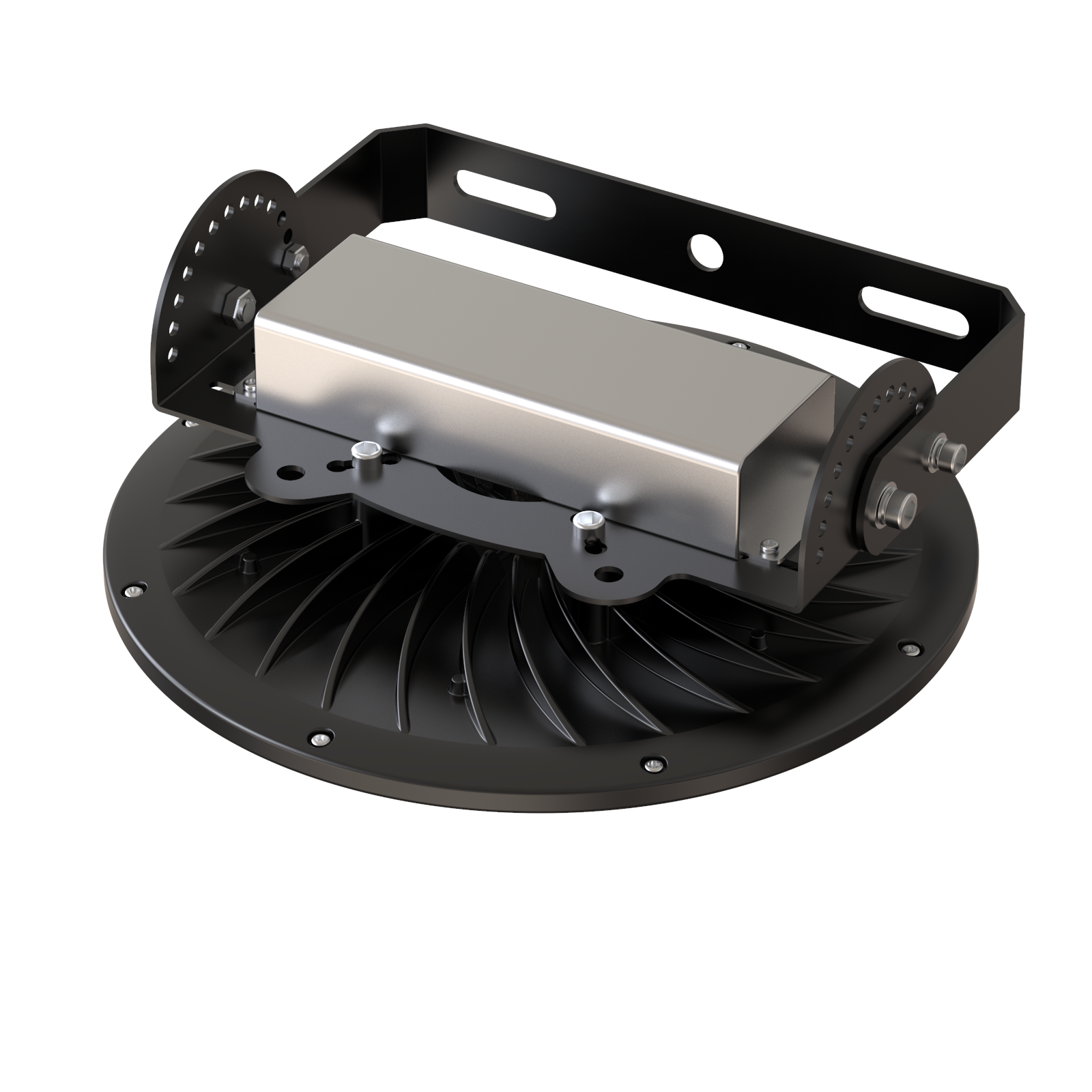
The UFO LED high bay housing is the single most important product in industrial LED lighting, accounting for the majority of fixture installations in warehouses, logistics centers, and manufacturing facilities globally. Its circular form factor with radial heat sink fins delivers 360° convective cooling in any mounting orientation — a critical advantage for industrial installations where fixtures may be repositioned as facility layouts change.

INDUSTRIAL STANDARD
Anerhui UFO LED High Bay Housing — Industrial Specification
- Wattage range: 100W, 150W, 200W, 240W, 300W
- Material: Die-cast ADC12 aluminum (A413 available for 200W+)
- IP rating: IP65 (IP66 on request)
- Ambient operating range: -40°C to +55°C
- Fin design: 20–28 radial fins, 25 mm height, 1.5 mm thickness
- Lens: 4 mm tempered glass, IK08 impact rated
- Fasteners: Stainless steel A2 with nylon-insert locking nuts
- Mounting: Hook mount standard; trunnion bracket optional; Zhaga socket available
- Surface treatment: TGIC polyester powder coat, RAL 9005 standard
- Certifications: CE, RoHS; UL on request
- Series available: Series 3, 4, 5 (increasing thermal performance)
Series Comparison: Which UFO High Bay for Your Application?
| Series | Wattage Range | Fin Count | Max Ambient | Best For |
|---|---|---|---|---|
| Series 3 | 100W–150W | 20 fins | 45°C | Standard warehouses, cool climates, logistics |
| Series 4 | 100W–250W | 24 fins | 55°C | General industrial, tropical climates, factories |
| Series 5 | 150W–300W | 28 fins | 55°C | High-power industrial, steel/foundry, 24/7 operations |
5. LED Shoebox Housing for Large Industrial Outdoor Areas
Industrial facilities generate significant outdoor lighting requirements: loading docks, truck marshaling yards, outdoor storage areas, rail sidings, and large industrial campus perimeters all require high-power area lighting. The LED shoebox (parking lot) housing is the standard solution for these applications, delivering wide-area uniform illumination from pole-mounted fixtures.

Industrial outdoor LED shoebox housings face a distinct set of requirements compared to commercial parking lot applications: heavier mounting structures (10–12 m poles to clear truck trailer height), higher wattage requirements (150W–350W for large marshaling yards), and greater exposure to vehicle exhaust, fuel vapor, and industrial atmospheric pollutants. Anerhui’s shoebox housings for industrial applications are specified with IP66 rating (vs IP65 standard for commercial parking lots) and superdurable polyester powder coat for maximum atmospheric corrosion resistance.
Loading dock lighting note: Loading docks present a unique lighting challenge — fixtures must illuminate both the indoor dock area and the exterior approach, while tolerating vibration from truck docking impacts and pressure washing. Specify IP66 shoebox housings with stainless steel yoke hardware and vibration-rated mounting adapters for dock applications. Contact Anerhui’s engineering team to discuss dock-specific mounting solutions.
6. LED Shop Light Housing for Lower-Ceiling Industrial Spaces
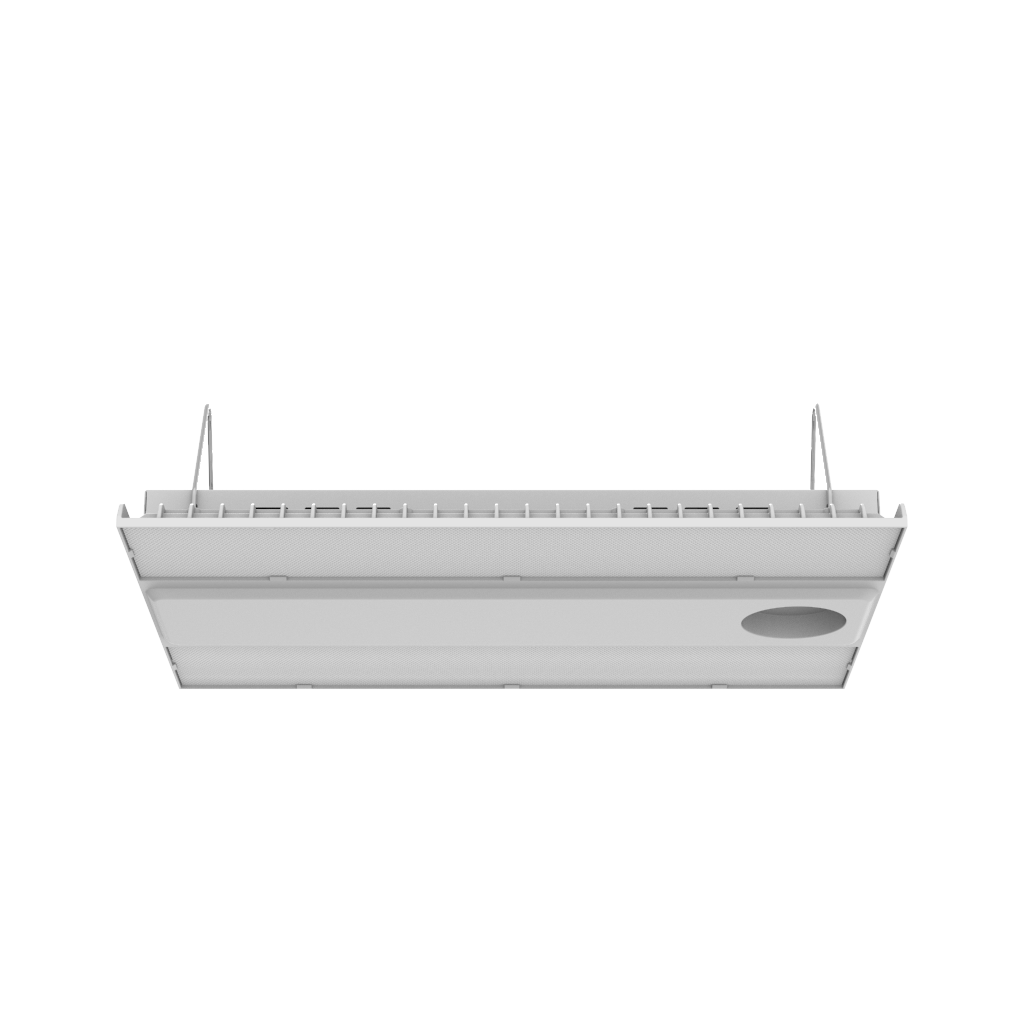
Not all industrial spaces have the 8–15 m ceiling heights that justify UFO high bay fixtures. Maintenance workshops, ground-floor production areas, mezzanine levels, and industrial retail spaces with 3–6 m ceilings are better served by LED shop light housings — linear form factor fixtures that provide uniform illumination at lower mounting heights with wider light distribution.
LED shop light housings for industrial applications require the same IP and vibration resistance considerations as high bay housings, with the additional requirement of surface-mount or chain-hang compatibility for low-ceiling industrial spaces. Anerhui’s shop light housing range covers 40W–120W in single and twin-tube configurations, with IP65 rating and tempered glass lens protection suited to general industrial maintenance and workshop environments. View the LED shop light housing range.
7. Application Guide by Industrial Facility Type
| Facility Type | Recommended Housing | IP Rating | Wattage Range | Special Requirements |
|---|---|---|---|---|
| General warehouse (dry) | UFO High Bay | IP65 | 100W–200W | — |
| Logistics / e-commerce center | UFO High Bay + smart controls | IP65 | 100W–200W | Zhaga socket for occupancy sensing; smart housing design |
| Manufacturing / assembly | UFO High Bay Series 4–5 | IP65 | 150W–250W | High CRI (≥80) for quality inspection areas |
| Steel / foundry / forge | UFO High Bay Series 5 | IP65–IP66 | 200W–300W | A413 alloy; max ambient 55°C; IK08 impact |
| Food processing / beverage | UFO High Bay IP66 | IP66 | 100W–200W | High-pressure washdown; stainless fasteners; food-safe coating |
| Cold storage (-25°C) | UFO High Bay cold-rated | IP65 | 100W–150W | Cold-start driver (-40°C); tempered glass lens |
| Car wash / vehicle wash | UFO High Bay IP67 | IP67 | 100W–150W | Full submersion-adjacent sealing; anti-corrosion hardware |
| Workshop / maintenance bay | Shop Light | IP65 | 40W–120W | Surface or chain mount; 3–6 m ceiling |
| Outdoor loading dock / yard | Shoebox / Street Light | IP66 | 150W–350W | Pole mount; vibration-rated yoke; atmospheric corrosion resistance |
| Agricultural / barn | Barn Light | IP65 | 100W–300W | Wide-area distribution; corrosion resistance against ammonia |
8. Wattage & Mounting Height Selection Guide
Selecting the correct wattage for an industrial LED housing requires matching the fixture’s lumen output to the required illuminance level at working plane height, accounting for ceiling height, fixture spacing, and the reflectance of surrounding surfaces. The following table provides practical starting points based on IES RP-7 industrial lighting recommendations.
| Ceiling Height | Application | Target Illuminance (lux) | Recommended Wattage | Typical Spacing (m) |
|---|---|---|---|---|
| 4–6 m | Workshop, maintenance, light assembly | 300–500 lux | 60W–100W UFO or Shop Light | 4–5 m |
| 6–8 m | General warehouse, bulk storage | 150–200 lux | 100W UFO | 5–6 m |
| 6–8 m | Logistics, picking, sorting | 200–300 lux | 150W UFO | 5–6 m |
| 8–10 m | General warehouse / logistics | 200–300 lux | 150W–200W UFO | 6–7 m |
| 10–12 m | High-rack warehouse, manufacturing | 200–300 lux | 200W–240W UFO | 6–8 m |
| 12–15 m | Steel plant, assembly hall, sports | 300–500 lux | 240W–300W UFO | 7–9 m |
Important: These figures assume LED module efficacy of 140–160 lm/W and maintenance factor of 0.8. Always conduct a full photometric calculation using your specific LED module’s IES photometry file and verify uniformity ratio (Emin/Eavg ≥ 0.7 per IES RP-7) before finalizing fixture count and spacing. Anerhui can provide IES photometry files for all standard housing configurations upon request.
9. Smart Controls for Industrial LED Housings: Occupancy-Based Energy Savings
The combination of industrial LED high bay fixtures and smart occupancy sensing delivers the highest energy savings ROI of any commercial lighting application. Industrial warehouses and logistics centers have highly variable occupancy patterns — aisles are occupied for picking and putaway operations but empty for extended periods between activities. Occupancy-based dimming can reduce energy consumption by 40–65% versus fixed-output LED operation.
Anerhui’s industrial high bay housings are available with integrated Zhaga Book 18 sockets on Series 4 and Series 5 models, allowing plug-and-play installation of PIR occupancy sensors and Bluetooth Mesh nodes without any modification to the housing or wiring. This enables phased smart deployment — facilities can install standard LED housings initially and add smart nodes at any future date, protecting the housing investment while deferring sensor procurement costs.
For a complete technical guide to smart LED housing design including DALI-2, Zhaga Book 18, and NFC configuration, see our smart LED housing design guide.
| Industrial Application | Smart Feature | Typical Energy Saving vs Fixed LED |
|---|---|---|
| Warehouse aisle lighting | PIR occupancy + daylight harvesting | 40–65% |
| Logistics / sorting center | Bluetooth Mesh zone dimming + PIR | 35–55% |
| Manufacturing floor | Task-based DALI-2 scene control | 25–40% |
| Cold storage / freezer | Door-triggered occupancy dimming | 50–70% |
| Outdoor loading yard | Photocell + motion detection | 45–60% |
10. Sourcing Industrial LED Housings: Key Specifications Checklist
When sourcing industrial LED housing solutions from a die-cast aluminum manufacturer, use the following checklist to ensure the housing specification genuinely matches your industrial application requirements — not just the marketing description.

Thermal Performance
- Request CFD simulation data at your specific wattage AND ambient temperature (not just 25°C datasheet values)
- Confirm alloy: A413 for ≥200W in high-ambient environments; ADC12/A383 acceptable for ≤150W standard conditions
- Verify fin count, height, and pitch against thermal simulation data — not just housing diameter
IP & Environmental
- Request IP test report performed on fully assembled housing (with gasket, lens, and cable glands installed)
- Confirm IP rating tested at operating temperature range, not just ambient (thermal cycling affects gasket compression)
- Specify lens material: tempered glass for impact resistance; polycarbonate only for low-impact indoor applications
- For washdown applications: confirm gasket material (silicone recommended; EPDM acceptable for cold storage)
Vibration & Mechanical
- Confirm stainless steel fasteners (not zinc-plated carbon steel) for corrosive industrial environments
- Ask specifically: “How is the driver mechanically secured inside the housing?” — foam mounts indicate vibration engineering; rigid screw mounts only indicate it is not
- For crane-adjacent installations: request IEC 60068-2-6 vibration test report
Smart Compatibility
- Confirm Zhaga Book 18 socket availability for your target housing models
- Verify DALI-2 driver compartment dimensions if specifying smart controls
- Check antenna window availability for wireless mesh applications
For the complete supplier qualification framework covering all industrial housing requirements, download our LED housing supplier audit guide with full industrial specifications checklist.
Ready to source industrial LED housings?
Anerhui supplies die-cast aluminum industrial LED housing SKD kits to manufacturers and distributors across North America, Europe, Southeast Asia, and the Middle East. Request samples, get a volume quote, or start a custom housing development project.
📦 Request Free Industrial Housing Sample | 📞 Discuss Your Industrial Project | 🔍 Browse High Bay Housing Range
11. Frequently Asked Questions About Industrial LED Housing Solutions
What is the best LED housing for warehouse industrial lighting?
For warehouse and industrial applications with ceiling heights of 6–15 m, UFO LED high bay housings made from die-cast aluminum are the industry standard. They combine radial heat sink fins for maximum thermal management (critical for 100W–300W continuous operation), IP65 ingress protection, and robust mounting systems for high-vibration environments. For lower ceilings (4–6 m), LED shop light housings are more appropriate.
What IP rating do industrial LED housings need?
IP rating requirements depend on the facility zone: dry warehouses and factories require IP54 minimum; general industrial with washdown requires IP65; food processing and beverage with high-pressure steam cleaning requires IP66; car wash and submersion-adjacent areas require IP67. Always specify IP testing on fully assembled housings, not bare castings. See the full IP selection matrix in Section 3 above.
How does vibration affect industrial LED housing design?
Industrial vibration from cranes, presses, and forklifts can loosen fasteners, fatigue driver solder joints, and cause gasket compression loss. Industrial-grade LED housings address this through stainless steel locking fasteners, foam-mounted driver vibration isolation, captured lens frames (not adhesive alone), and rigid die-cast aluminum construction that eliminates sheet metal flex fatigue. Request IEC 60068-2-6 vibration test reports for crane-adjacent or heavy-press installations.
What wattage LED high bay housing do I need for a warehouse?
General guidance: 6–8 m ceiling — 100W UFO (150–200 lux); 8–10 m — 150–200W (200–300 lux); 10–12 m — 200–240W (200–300 lux); 12–15 m — 240–300W (300–500 lux for picking areas). Always verify with a photometric calculation using actual IES fixture files and check uniformity ratio ≥ 0.7 per IES RP-7. Anerhui provides IES photometry files for all standard housing configurations.
Can industrial LED housings be used in cold storage facilities?
Yes. Die-cast aluminum housings maintain structural integrity and IP65 sealing across the full cold storage operating range (-40°C to +55°C). Key cold storage specifications: tempered glass lens (polycarbonate becomes brittle at -25°C); cold-start rated driver (typically -40°C minimum); silicone gaskets (maintain flexibility to -60°C); and sealed cable entries rated for condensation cycling on door-open events.
What is the difference between UFO high bay and linear high bay LED housings?
UFO high bay housings have a circular form factor with radial fins for 360° convective cooling and wide-angle point-source distribution (90°–120° beam), ideal for general warehouse and factory area lighting. Linear high bay housings have a rectangular form factor better suited to aisle and rack lighting with elongated distribution, and for retrofit of existing fluorescent high bay installations with linear mounting infrastructure.
Conclusion
Industrial LED housing solutions are not a single product — they are a family of engineering-optimized enclosures matched to the specific thermal, environmental, mechanical, and photometric demands of each industrial facility type. From the 300W Series 5 UFO high bay in a 55°C steel plant to the IP66 shoebox on a logistics center loading dock, every housing specification decision compounds over the fixture’s 25-year service life.
Anerhui’s industrial LED housing range — covering UFO high bay Series 3–5, shoebox, shop light, and barn light housings — is engineered from the ground up for continuous industrial operation. With thermal simulation at design stage, in-house IP testing on fully assembled housings, stainless steel hardware as standard, and Zhaga-ready smart options across the range, Anerhui is equipped to be your industrial LED housing manufacturing partner at any scale.
Contact our engineering team to discuss your industrial application, request free housing samples, or explore our complete industrial product catalog.
References & Further Reading
- Illuminating Engineering Society (IES) — RP-7 Industrial Lighting, LM-79, LM-80
- International Electrotechnical Commission (IEC) — IEC 60529 IP ratings, IEC 60068-2-6 vibration testing
- U.S. Department of Energy SSL Program — Industrial LED lighting resources
- Anerhui: Heat Dissipation LED Housing Guide
- Anerhui: LED Housing Surface Treatments Guide
- Anerhui: Smart LED Housing Design Guide
- Anerhui: LED Light Housing Manufacturer Guide
- Anerhui: Die-Cast Aluminum LED Housing Complete Guide
© 2026 Anerhui Lighting Technology Co., Ltd. All rights reserved. | Privacy Policy | Sitemap | Blog
This article is reviewed and updated to reflect current industrial lighting standards and Anerhui product developments.