
By Anerhui Engineering Team | Last updated: May 2026 | LED component materials die-cast aluminum material comparison thermal conductivity LED housing selection
📋 Table of Contents
- Why Material Selection Is the Most Consequential LED Housing Decision
- Master Comparison Table: All Materials at a Glance
- Die-Cast Aluminum: The Commercial Standard
- Extruded Aluminum: High Conductivity, Limited Geometry
- Stamped Steel: Low Cost, High Thermal Penalty
- Injection-Molded Plastic: Indoor Low-Power Only
- Zinc Die Cast: Precision Components, Not Primary Housings
- Thermal Performance Deep Dive: Material Impact on Junction Temperature
- IP Rating Achievability by Material
- Sustainability & Recyclability
- Material Selection Guide by Application
- Frequently Asked Questions
The choice of housing material is the single most consequential engineering decision in LED luminaire design — more impactful on long-term performance than LED package selection, driver efficiency, or optic design. Material choice determines junction temperature (and therefore LED lifespan), IP protection reliability, structural longevity, UV resistance, recyclability, and total cost of ownership across the fixture’s 25-year service life.
Yet material selection is often made implicitly, by copying a competitor’s design or defaulting to the lowest unit-cost option, rather than through systematic engineering comparison. This guide provides the data B2B buyers and lighting engineers need to make informed, application-matched material decisions for LED component materials selection — covering die-cast aluminum, extruded aluminum, stamped steel, injection-molded plastic, and zinc die cast across 12 performance dimensions.
This article is part of Anerhui’s technical series on LED housing engineering. For deeper dives into specific material applications, see our die-cast aluminum LED housing complete guide, our heat dissipation LED housing guide, and our LED housing surface treatments guide. Material property data is sourced from the Aluminum Association, NADCA, and peer-reviewed materials science literature.
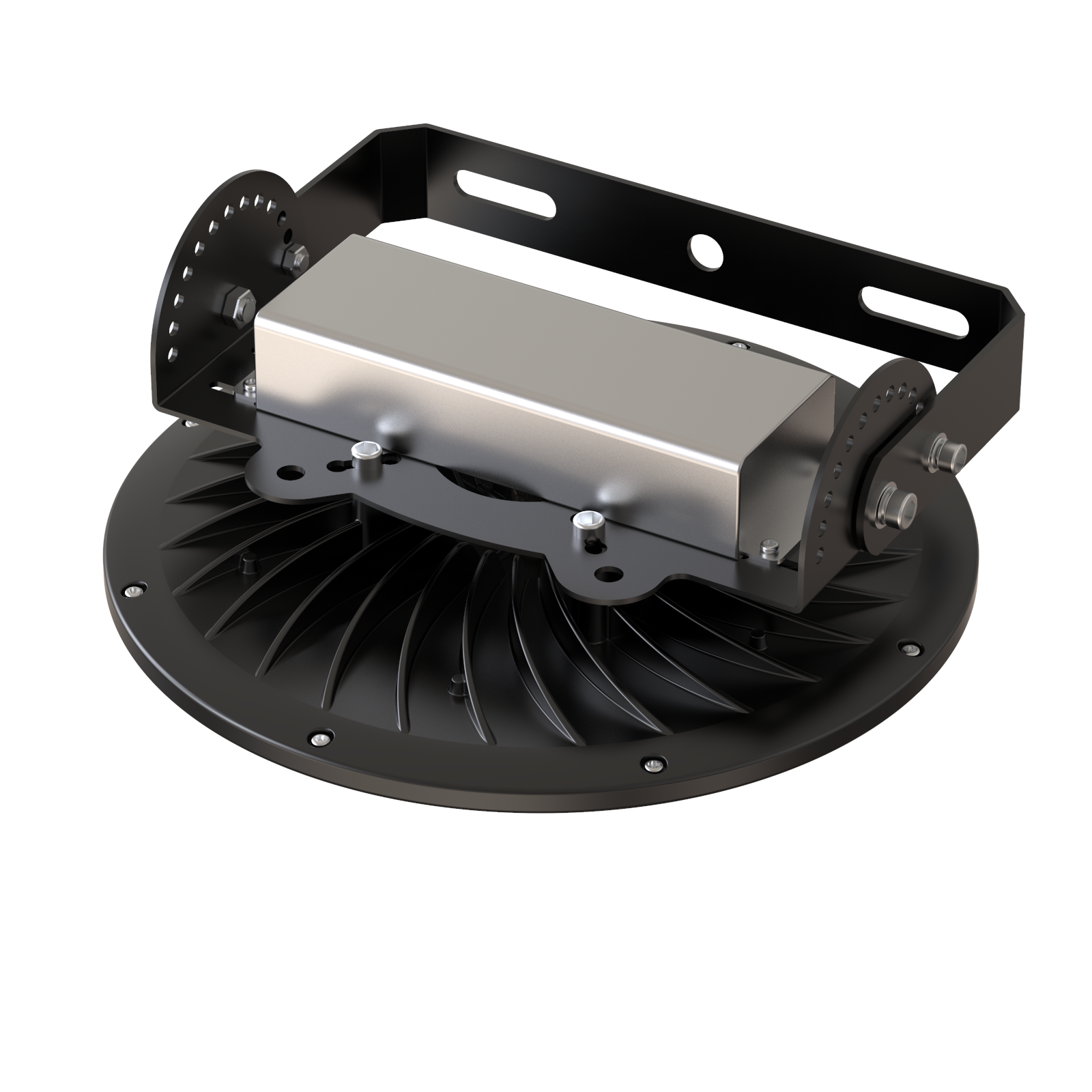
1. Why Material Selection Is the Most Consequential LED Housing Decision
Every key performance metric of a commercial LED luminaire traces back to the housing material. Consider the cascade of consequences from a single material decision — choosing injection-molded polycarbonate instead of die-cast aluminum for a 150W commercial high bay housing:
- Thermal: Polycarbonate thermal conductivity of 0.2 W/(m·K) vs aluminum’s 96 W/(m·K) — a 480× difference — produces junction temperatures 30–50°C higher under identical operating conditions. At 95°C Tj versus 65°C Tj, TM-21 lifetime projections drop from 80,000+ hours to under 35,000 hours.
- IP reliability: Plastic’s thermal expansion coefficient (70–130 µm/m·°C) is 3–6× higher than aluminum’s (21–23 µm/m·°C), causing progressive gasket compression loss through thermal cycling — IP65 rating degrades to effective IP54 or lower within 2–3 years of outdoor operation.
- UV degradation: Even UV-stabilized engineering plastics show surface chalking, color fade, and loss of impact resistance within 5–8 years of outdoor UV exposure in tropical or high-altitude environments. Aluminum oxide surface is inherently UV-inert.
- Service life: A plastic-housing fixture requiring replacement at year 7 versus an aluminum-housing fixture lasting 25 years generates 3.5× the replacement labor and material cost over a 25-year project lifecycle.
These are not marginal differences. They represent the difference between a product that builds a lighting brand’s reputation and one that generates warranty claims. The sections below quantify every relevant performance dimension for each major housing material.
2. Master Comparison Table: All LED Housing Materials at a Glance
| Property | Die-Cast Aluminum (A380) | Extruded Aluminum (6063) | Stamped Steel | Injection-Molded Plastic (PC/ABS) | Zinc Die Cast |
|---|---|---|---|---|---|
| Thermal conductivity (W/m·K) | 96 | 160–200 | 45–60 | 0.1–0.3 | 108–113 |
| Density (g/cm³) | 2.71 | 2.70 | 7.85 | 1.1–1.4 | 6.6 |
| Tensile strength (MPa) | 317 | 241 | 400–600 | 40–80 | 359 |
| 3D geometry capability | ✅ Full 3D | ⚠️ Linear only | ⚠️ 2.5D stamped | ✅ Full 3D | ✅ Full 3D |
| Integrated heat sink fins | ✅ Radial, compound | ⚠️ Linear parallel only | ❌ Not feasible | ❌ Not thermally effective | ✅ Yes (heavier) |
| IP65–IP67 achievability | ✅ Reliable (±0.03 mm tolerance) | ⚠️ Moderate (end-cap sealing) | ⚠️ Requires additional sealing | ⚠️ Degrades over time | ✅ Reliable |
| UV resistance | ✅ Inherent (Al₂O₃ surface) | ✅ Inherent | ⚠️ Coating-dependent | ⚠️ Degrades 5–10 yr outdoor | ✅ Good (plated/coated) |
| Corrosion resistance | Good (treated) | Excellent (anodized) | Poor (requires coating) | Excellent (inherent) | Good (plated) |
| Dimensional tolerance | ±0.03–0.05 mm | ±0.05–0.15 mm | ±0.1–0.3 mm | ±0.1–0.5 mm | ±0.02–0.04 mm |
| Typical service life (outdoor) | 25+ years | 20+ years | 10–15 years | 5–10 years | 15–20 years |
| Recyclability | ✅ 100% (infinite cycles) | ✅ 100% | ✅ 100% | ⚠️ Limited (downcycling) | ✅ 100% |
| Relative material cost | 1.0× (base) | 0.9–1.1× | 0.5–0.7× | 0.3–0.6× | 1.5–2.0× |
| Best application | Commercial/industrial LED — all categories | Linear fixtures, retrofit profiles | Low-cost indoor, non-thermal | Indoor decorative, low-power (<15W) | Small precision components |
3. Die-Cast Aluminum: The Commercial Standard for LED Housing
Die-cast aluminum has become the dominant material for commercial and industrial LED housings globally because it uniquely combines the thermal performance, geometric freedom, production precision, and material durability required by professional luminaire design. No other material delivers competitive performance across all dimensions simultaneously — other materials win on one or two metrics but fall short on the others that matter.
✅ RECOMMENDED — Commercial & Industrial
Die-Cast Aluminum (A380 / ADC12 / A413)
- Thermal conductivity: 92–121 W/(m·K) depending on alloy
- Key advantage: Only material that enables 3D integrated heat sink fins, precision gasket grooves, cable channels, sensor compartments, and Zhaga sockets in a single-operation casting
- IP capability: IP65–IP67 reliably achieved at ±0.03–0.05 mm gasket groove tolerance
- Service life: 25+ years outdoor with proper surface treatment
- Typical Tj at 150W, 40°C ambient: 72–82°C (well within L70 lifetime target)
- Production scalability: 500–50,000+ identical units per month from single tool
- Recyclability: 100% — can be recycled infinite times without property loss
- Best alloys: A380 (general commercial), ADC12/A383 (thin-wall / smart housings), A413 (high-power thermal priority)
The critical manufacturing advantage of die casting for LED housings is the ability to produce complex 3D thermal geometries — radial fin arrays, hollow cooling channels, compound-angle fins — that are impossible with any other process. For a complete technical analysis, see our die-cast aluminum LED housing manufacturing guide.
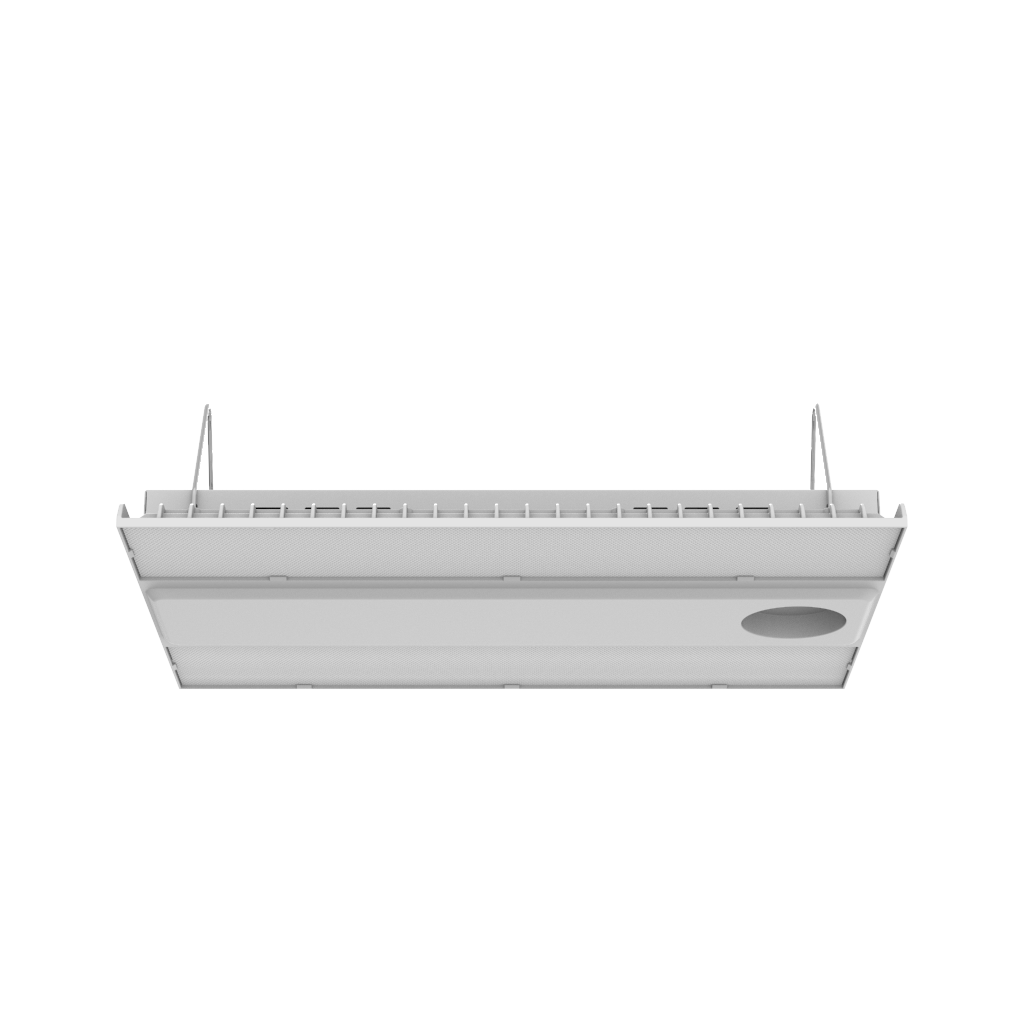
4. Extruded Aluminum: High Conductivity, Limited Geometry
Extruded aluminum (typically 6063 alloy) offers the highest bulk thermal conductivity of any common LED housing material at 160–200 W/(m·K) — significantly better than A380 die cast at 96 W/(m·K). However, the extrusion process imposes a fundamental geometric constraint: it can only produce constant cross-sections along a linear axis. This makes extrusion highly capable for linear LED strip light housings, T8/T5 tube replacements, and rectangular panel frames, but incapable of producing the radial fins, integrated mounting bosses, cable channels, and sensor compartments that professional commercial luminaires require.
✅ GOOD — Linear Fixtures & Retrofit Profiles
Extruded Aluminum (6063 / 6061)
- Thermal conductivity: 160–200 W/(m·K) — highest of all common housing materials
- Critical limitation: Linear cross-section only — no radial fins, no integrated bosses, no 3D geometry
- IP capability: IP65 achievable with sealed end caps, but less reliable than die cast due to end-cap joint sealing variability
- Best applications: Linear LED strip housings, T-bar retrofit profiles, LED panel frames, linear high bay (shop light) housings
- Not suitable for: UFO high bays, street lights, canopy lights, wall packs, garden lights — all requiring 3D geometry
- Cost vs die cast: Similar material cost; lower tooling cost (no die); higher secondary machining cost for end features
For Anerhui’s LED shop light housings — which use a linear form factor — extruded aluminum profiles are used for the main body, combined with die-cast aluminum end caps that provide the 3D geometry for mounting, cable entry, and driver housing.
5. Stamped Steel: Low Cost, High Thermal Penalty
Stamped (pressed) steel is the lowest-cost housing material in the LED industry, and it is also the most thermally compromised for any application involving meaningful heat generation. Steel’s thermal conductivity of 45–60 W/(m·K) is roughly half that of aluminum alloys, but more critically, stamped steel cannot produce integrated fins — meaning the entire thermal resistance from the LED mounting surface to ambient air must be overcome by a flat steel shell with no surface area amplification.
⚠️ LIMITED — Indoor, Low-Power, Non-Thermal
Stamped / Pressed Steel
- Thermal conductivity: 45–60 W/(m·K) — roughly half of aluminum
- Critical limitation: Cannot produce integrated fins; high Tj at any meaningful wattage
- Typical Tj at 150W, 40°C ambient: 105–120°C — approaching or exceeding Tj,max for most LEDs
- IP capability: Requires caulk or butyl tape sealing — unreliable under thermal cycling and vibration
- Corrosion resistance: Poor — requires zinc galvanizing plus powder coat for outdoor use
- Cost advantage: 30–50% lower material cost than aluminum die cast
- Appropriate for: Indoor low-power (≤30W) fixtures with no thermal requirements; junction box covers; non-illuminated enclosures
- Not suitable for: Any outdoor commercial application; any fixture above 30W; any IP65+ requirement
Total cost of ownership warning: The 30–50% unit cost saving of stamped steel versus die-cast aluminum is typically eliminated within 3–4 years in commercial applications through higher replacement rates, warranty claims from thermal failure, and IP degradation in outdoor installations. For a quantified TCO comparison, see our die-cast aluminum LED housing guide.
6. Injection-Molded Plastic: Indoor Low-Power Applications Only
Injection-molded plastics — primarily polycarbonate (PC), ABS, PC/ABS blends, and nylon (PA66) — are the lowest-cost housing materials and offer excellent design freedom for complex 3D shapes. However, their thermal conductivity of 0.1–0.3 W/(m·K) is categorically different from all metallic alternatives, making them thermally unsuitable for any LED fixture above approximately 15–20W in enclosed configurations.
❌ NOT RECOMMENDED — Above 20W or Outdoor Use
Injection-Molded Plastic (PC / ABS / PA66)
- Thermal conductivity: 0.1–0.3 W/(m·K) — 300–500× lower than die-cast aluminum
- Typical Tj at 150W, 40°C ambient: 130–150°C+ — at or beyond Tj,max, causing rapid failure
- IP degradation: Thermal expansion (70–130 µm/m·°C) causes progressive gasket compression loss; IP65 degrades to effective IP54 within 2–3 years outdoors
- UV stability: Even UV-stabilized grades show chalking and embrittlement within 5–8 years at high UV index
- Service life (outdoor): 5–10 years maximum; 3–5 years in tropical/high-UV environments
- Cost advantage: 40–70% lower material cost than aluminum die cast
- Appropriate for: Indoor decorative fixtures ≤15W; recessed downlights with low drive current; bulb housings; lens and diffuser components
- Recyclability: Limited — most engineering plastics are downcycled, not truly recycled
Plastic remains widely used for LED bulb housings at 5–15W where thermal requirements are modest and indoor UV exposure is minimal — Anerhui’s LED bulb housing range uses a combination of aluminum heat sink and polycarbonate diffuser globe, combining the thermal capability of aluminum with the light-transmitting properties of plastic for the globe component.
7. Zinc Die Cast: Precision Small Components, Not Primary Housings
Zinc die casting offers the highest dimensional precision of any casting process (±0.02–0.04 mm) and excellent surface finish for electroplating and decorative finishing. However, zinc’s density of 6.6 g/cm³ — 2.5× heavier than aluminum — and significantly higher material cost make it impractical as the primary housing material for commercial LED luminaires of any meaningful size.
✅ GOOD — Small Precision Components Only
Zinc Die Cast (Zamak alloys)
- Thermal conductivity: 108–113 W/(m·K) — comparable to aluminum A380
- Density: 6.6 g/cm³ — 2.5× heavier than aluminum (major weight penalty at scale)
- Dimensional precision: ±0.02–0.04 mm — highest of all casting methods
- Surface quality: Excellent — accepts electroplating, chrome, nickel, powder coat
- Cost: 1.5–2.0× higher than die-cast aluminum per unit weight
- Best applications: Decorative hardware, connector bodies, optical bezels, small mounting brackets, lamp holders ≤20W
- Not suitable for: Primary housing shells for commercial fixtures — weight and cost penalty is prohibitive
8. Thermal Performance Deep Dive: Material Impact on Junction Temperature
The following analysis quantifies the real-world junction temperature impact of material selection for a representative 150W commercial UFO high bay fixture at 45°C ambient temperature, using a standardized fin geometry (20 fins, 25 mm height, 5 mm pitch) across all materials.

| Material | Thermal Conductivity (W/m·K) | Estimated Tj at 150W, 45°C Ambient | TM-21 L70 Lifetime (hrs) | Years to L70 (20 hrs/day) |
|---|---|---|---|---|
| Die-Cast Al (A413) | 121 | 72°C | 90,000+ | 12.3 years |
| Die-Cast Al (A380) | 96 | 78°C | 75,000 | 10.3 years |
| Extruded Al (6063) | 170 | 68°C | 100,000+ | 13.7 years |
| Zinc Die Cast | 113 | 76°C | 80,000 | 11.0 years |
| Stamped Steel | 50 | 98°C | 28,000 | 3.8 years |
| Injection-Molded PC | 0.2 | 135°C+ | <5,000 | <0.7 years |
The data is unambiguous: for any commercial LED fixture above 30W, only aluminum-family materials (die cast or extruded) and zinc die cast maintain junction temperatures within viable operating ranges. Steel is marginal at best; plastic is categorically unsuitable. For the complete thermal management methodology including CFD simulation and LM-80/TM-21 lifetime projection, see our heat dissipation LED housing guide.
9. IP Rating Achievability by Material
IP rating performance over time — not just at initial factory test — is where material differences become most apparent in commercial installations. The following table compares long-term IP reliability across housing materials:
| Material | Initial IP65 Achievability | IP65 After 5 Years Outdoor | Primary Failure Mechanism |
|---|---|---|---|
| Die-Cast Aluminum | ✅ Reliable (±0.03 mm tolerance) | ✅ Maintained with quality gasket | Gasket compression loss (addressable with correct durometer) |
| Extruded Aluminum | ✅ Good (end-cap sealing required) | ✅ Mostly maintained | End-cap joint seal degradation |
| Stamped Steel | ⚠️ Requires additional sealing ops | ⚠️ Degraded (butyl tape failure) | Butyl tape shrinkage and adhesion loss under thermal cycling |
| Injection-Molded Plastic | ⚠️ Achievable initially | ❌ Significantly degraded | Thermal expansion / contraction progressively loosening gasket compression over 2–3 years |
| Zinc Die Cast | ✅ Reliable (±0.02 mm tolerance) | ✅ Maintained | Minimal — zinc’s low thermal expansion maintains gasket compression |
For a detailed breakdown of IP gasket design, sealing surface requirements, and testing protocols, see our LED housing surface treatments guide which includes IP integrity testing methodology at full operating temperature range.
10. Sustainability & Recyclability of LED Housing Materials
As commercial building projects increasingly require environmental product declarations (EPDs), LEED credits, and material sustainability documentation, the recyclability of LED housing materials has become a procurement criterion alongside thermal and mechanical performance.

| Material | Recyclability | Recycled Content Available | End-of-Life Carbon Impact | LEED / EPD Compatibility |
|---|---|---|---|---|
| Die-Cast Aluminum | ✅ 100% — infinite cycles | ✅ Up to 95% recycled content | Negative (recycling saves energy) | ✅ Full — EPD available |
| Extruded Aluminum | ✅ 100% — infinite cycles | ✅ Up to 95% recycled content | Negative | ✅ Full |
| Stamped Steel | ✅ 100% | ✅ High recycled content common | Slightly negative | ✅ Full |
| Injection-Molded Plastic | ⚠️ Limited (downcycling only) | ⚠️ Limited — recycled PC/ABS rarely used for optical housing | Positive (landfill or incineration) | ⚠️ Limited credit |
| Zinc Die Cast | ✅ 100% | ✅ High recycled content available | Slightly negative | ✅ Full |
Aluminum’s recyclability advantage is particularly compelling: recycling aluminum requires only 5% of the energy needed to produce primary aluminum — meaning that specifying aluminum LED housings in a LEED project can contribute to both MR (Materials and Resources) credits for recycled content and potentially EA (Energy and Atmosphere) credits when combined with energy-efficient LED performance. The Aluminum Association publishes Environmental Product Declarations (EPDs) compatible with LEED v4.1 documentation requirements.
11. Material Selection Guide by Application
| Application | Recommended Material | Reason | Anerhui Product |
|---|---|---|---|
| Warehouse UFO high bay (100W–300W) | Die-Cast Aluminum (ADC12/A413) | Radial fins only achievable in die cast; IP65; 24/7 thermal requirement | UFO High Bay Series 3–5 |
| Municipal street light (30W–200W) | Die-Cast Aluminum (A380) | IP66; complex housing geometry; Zhaga socket; 25-year service life | Street Light Housing |
| Commercial wall pack (20W–120W) | Die-Cast Aluminum (A380) | IP65; aesthetic design freedom; forward-throw fin orientation | Wall Pack Housing |
| Gas station canopy (40W–300W) | Die-Cast Aluminum (ADC12) | IP65; fuel vapor environment; perimeter fin design for ceiling mount | Canopy Light Housing |
| Linear shop light (40W–120W) | Extruded Al body + Die-Cast Al end caps | Linear form benefits from extrusion profile; end caps need die-cast complexity | Shop Light Housing |
| Landscape garden light (20W–80W) | Die-Cast Aluminum (A380) | Decorative 3D form; IP65; UV-stable surface; 25-year outdoor life | Garden Light Housing |
| LED bulb (5W–15W) | Al heat sink + PC globe | Low wattage allows plastic globe; Al heat sink handles thermal load | LED Bulb Housing |
| Smart housing with sensors | Die-Cast Aluminum (ADC12/A383) | Best fluidity for thin-wall sensor compartments; IP-rated antenna windows | Smart LED Housing Design |
| Indoor decorative fixture (≤15W) | Injection-Molded Plastic (PC) | Low thermal requirement; low cost; design freedom; no UV exposure | — |
| Decorative hardware / bezel | Zinc Die Cast | Best surface for chrome/nickel plating; highest dimensional precision | — |
Need help selecting the right material for your application? Anerhui’s engineering team provides material selection consultation — including alloy recommendation, thermal simulation at your specified wattage and ambient temperature, and surface treatment specification — as part of our standard pre-tooling DFM review process, at no charge. Contact our engineering team →
12. Frequently Asked Questions About LED Component Materials
What is the best material for LED housing?
Die-cast aluminum is the best material for commercial and industrial LED housings in the vast majority of applications. It offers thermal conductivity of 96–121 W/(m·K) — 300–500× better than plastics — combined with 3D design freedom for integrated heat sink fins, IP65–IP67 achievability at ±0.03 mm tolerance, 25+ year service life, and 100% recyclability. The only competitive alternatives are extruded aluminum for linear fixtures and zinc die cast for small precision decorative components.
Why is die-cast aluminum better than plastic for LED housings?
Die-cast aluminum outperforms plastic across every performance dimension that matters in commercial lighting: 300–500× better thermal conductivity; no UV-driven surface degradation; no thermal expansion-driven gasket compression loss; 25+ year vs 5–10 year outdoor service life; and consistent ±0.03 mm dimensional tolerance enabling reliable IP65–IP67 sealing versus plastic’s ±0.1–0.5 mm tolerance that makes consistent sealing unreliable over time.
What is the difference between die-cast and extruded aluminum for LED housings?
Extruded aluminum has higher bulk thermal conductivity (160–200 W/m·K for 6063 alloy vs 96 W/m·K for A380 die cast) but can only produce constant cross-sections along a linear axis — no radial fins, no integrated sensor compartments, no 3D mounting geometries. Die casting produces full three-dimensional geometries in a single operation, enabling radial fins for UFO high bays, integrated cable channels, Zhaga sockets, and precision gasket grooves — impossible with extrusion.
Is zinc die casting a good alternative to aluminum for LED housings?
Zinc die casting is suitable for small, high-precision LED housing components and decorative hardware but not for commercial luminaire primary housings. Zinc is 2.5× heavier than aluminum (6.6 vs 2.7 g/cm³) and costs 1.5–2.0× more per unit. Its advantages — highest dimensional precision and excellent plating surface — are relevant for connector bodies, optical bezels, and decorative lamp holders, not for the primary housing shell of commercial LED fixtures.
What aluminum alloy is used for LED housing die casting?
The three most common alloys are A380 (most widely used — balanced fluidity, strength, and 96 W/m·K thermal conductivity for general commercial housings); ADC12/A383 (better fluidity for thin-wall smart housing designs with sensor compartments); and A413 (highest thermal conductivity at 121 W/m·K and best fluidity — specified for high-power fixtures at 150W+ in high-ambient-temperature environments). See our detailed alloy comparison in the die-cast aluminum LED housing guide.
Can LED housing material affect IP rating performance over time?
Yes, significantly. Die-cast aluminum maintains IP65–IP67 over 25 years because its low thermal expansion coefficient (21–23 µm/m·°C) preserves consistent gasket compression through temperature cycling. Injection-molded plastic has 3–6× higher thermal expansion, causing progressive gasket compression loss — IP65 ratings routinely degrade to effective IP54 or lower within 2–3 years of outdoor operation. This is the most common hidden failure mode in plastic-housing LED fixtures in outdoor commercial installations.
Conclusion
The data in this guide leads to a clear conclusion: for commercial and industrial LED lighting applications above 20W in outdoor or semi-outdoor environments, die-cast aluminum is the only material that delivers competitive performance across all dimensions simultaneously — thermal management, IP reliability, UV resistance, service life, sustainability, and production scalability.
The cost advantage of lower-grade materials — particularly plastic and stamped steel — is illusory when viewed over the fixture’s total service life. The thermal penalties of these materials accelerate LED degradation, shorten driver life, and compromise IP integrity in ways that generate warranty claims and replacement costs that dwarf the initial purchase price saving within 3–5 years of installation.
Anerhui specializes in die-cast aluminum LED housing manufacturing, with in-house thermal simulation, alloy selection guidance, and DFM review services that ensure every housing design is optimized for your specific wattage, ambient temperature, and application environment. Contact our engineering team to discuss your material requirements, request free housing samples, or explore our complete product range.
References & Further Reading
- The Aluminum Association — Alloy data, EPDs, and sustainability documentation
- North American Die Casting Association (NADCA) — Die casting process standards
- Illuminating Engineering Society (IES) — LM-80, TM-21 LED lifetime standards
- U.S. DOE SSL Program — LED junction temperature and lifetime research
- Anerhui: Die-Cast Aluminum LED Housing Complete Guide
- Anerhui: Heat Dissipation LED Housing Guide
- Anerhui: LED Housing Surface Treatments Guide
- Anerhui: LED Light Housing Manufacturer Guide
- Anerhui: Industrial LED Housing Solutions Guide
- Anerhui: LED Commercial Lighting Housing Guide

Ready to source die-cast aluminum LED housings?
Anerhui manufactures the full range of commercial and industrial LED housings in die-cast aluminum — with in-house thermal simulation, alloy selection guidance, and surface treatment consultation for every project.
📦 Request Free Samples | 📞 Material Selection Consultation | 🔍 Browse Product Range
© 2026 Anerhui Lighting Technology Co., Ltd. All rights reserved. | Privacy Policy | Sitemap | Blog
This article is reviewed and updated to reflect current materials science data and Anerhui manufacturing capabilities.